The time prescreening costs
- Calls nobody picks up. You call back, leave a voicemail, call again. A good part of the day goes into trying to reach candidates.
- The same questions every time. The first few minutes of every call sound the same. They're necessary, but they tell you nothing about how the person does the job.
- Uneven notes. What was said on the phone ends up in the candidate profile more or less accurately, depending on how much time was left before the next meeting.
How the agent runs candidate prescreening
- You choose the questions. Prescreening questions and knockout criteria are set along with the role.
- The agent contacts the candidate. By voice call, text or WhatsApp, at a time that suits them. The conversation is disclosed as automated.
- The candidate profile fills itself in. Answers are transcribed word for word and stored in the candidate profile. Qualified candidates can book an interview slot directly.
Decision grid after prescreening
At the end of the conversation, each criterion falls into a simple category. The recruiter then decides.
| Criterion | Move forward | To discuss | Dealbreaker |
|---|---|---|---|
| Availability | Within the planned timeframe | One to two months later | Incompatible with the start date |
| Pay | Within range | Slightly above | Well above the range |
| Location and remote work | Compatible | Compatible with some adjustment | Incompatible |
| Must-have skill | Used recently | Used long ago or partially | Never used |
| Interest in the role | Clear and motivated | Hesitant, worth exploring | Not interested |
The criteria and thresholds are those of your job opening. Adapt the grid to each role.
What is candidate prescreening?
Prescreening is the first conversation with a candidate. It checks that they meet the role's basic requirements before an interview is set up, and it avoids tying up a hiring manager for someone who couldn't accept the offer. It's a short conversation, but it's also the one that gets put off most, because you have to reach every single person.
With Delectus, two agents handle it: the SMS prescreening agent and the voice prescreening agent. They follow the questions set for the role, and you find the results in the job's pipeline.
The questions in a good prescreen
An effective prescreen stays short. It checks what could derail the hire later: availability and notice period, salary expectations compared with the role's range, location and remote-work arrangements, or work authorization when the role requires it. Add one or two role-specific questions, such as a mandatory certification, and stop there.
These questions are set with the role, and they're the ones the agents will ask. Here's what a well-built conversation looks like for an accountant role in Toulouse.
- "The role is based in Toulouse with two remote days a week. Does that work for you?"
- "When could you be available?"
- "The role pays between €45,000 and €50,000 a year before tax. Is that in line with your expectations?"
- "Have you worked with an ERP before? Which one?"
- "Do you have any questions about the role before the next step?"
The SMS and voice prescreening agents: how they work together
The SMS prescreening agent usually opens the conversation. Its first message says it's an AI and asks for the candidate's consent to process their answers. The conversation then continues in natural language, with no form. The agent asks the job's questions, fills in the candidate profile with the answers and spots an answer that contradicts another one so it can ask for clarification. It also adapts its tone: more reassuring with a hesitant candidate, more direct with one in a hurry. The same conversation can happen on WhatsApp.
The voice prescreening agent takes over by phone, at the time agreed with the candidate or when the text goes unanswered. It introduces itself as an AI, rephrases, follows up when an answer is vague and answers simple questions about the role. It also filters out background noise, so a call taken on the street stays understandable. At the end, you get the transcript, a summary and the completed candidate profile.
What happens when a candidate doesn't reply?
Each channel has its advantages. The phone allows a richer conversation, but the candidate has to be free at the right moment. Text and WhatsApp let them reply when they can, on a break or in the evening.
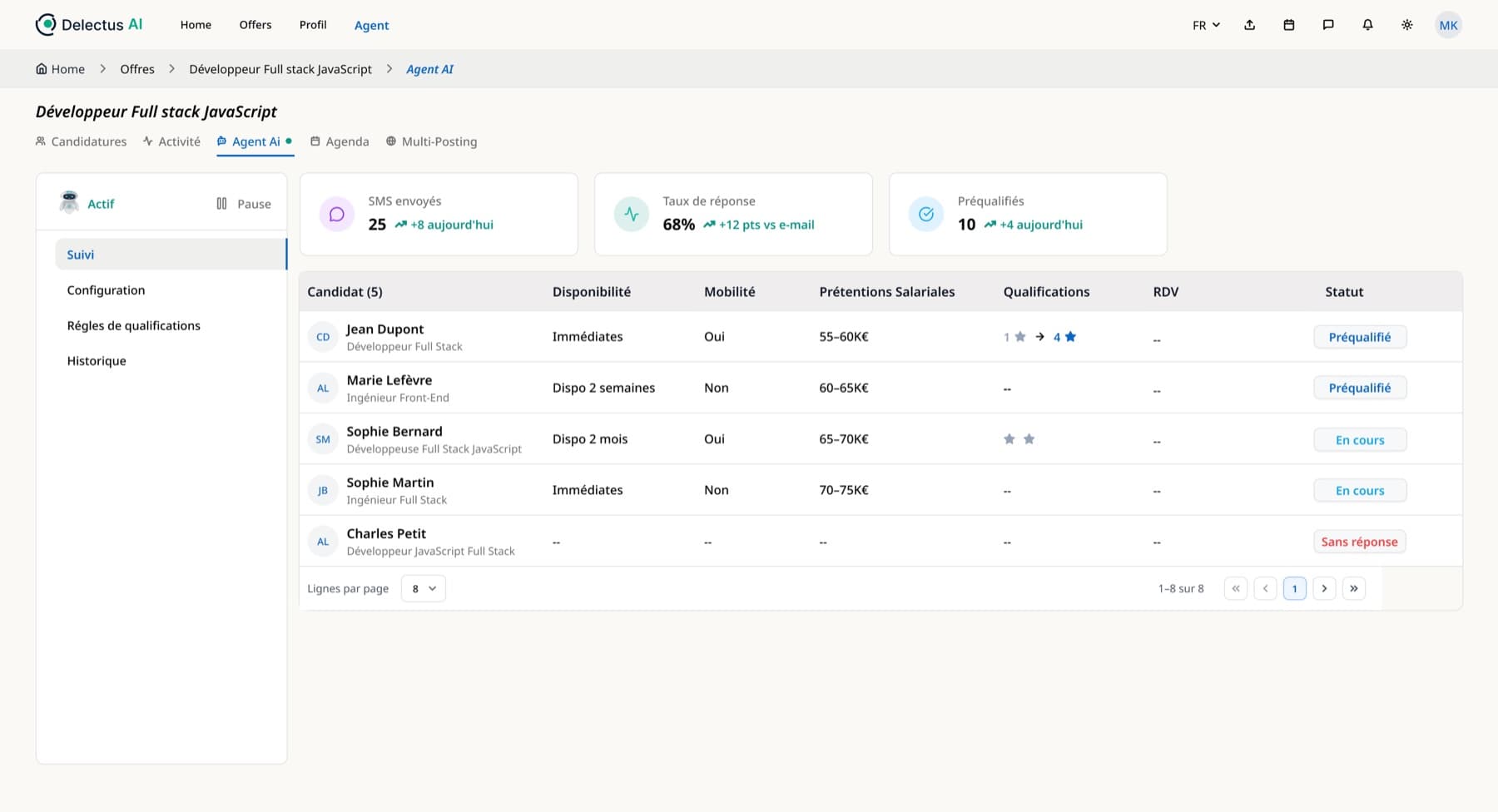
Follow-ups happen in a fixed order, designed to lose no one without pestering anyone. The SMS agent sends two follow-ups. With no reply, the voice agent calls. If the candidate still can't be reached, you get an alert and take over. In the job's kanban, you can see at any time who has been contacted, who has replied and who is still pending.
From prescreening to interview
Without an agent, prescreening happens on the phone, between missed calls and voicemails. Here, the conversation takes place when the candidate is available, and you then get the summary and the answer to each criterion. A notification tells you as soon as a candidate has replied. You only call back the candidates worth moving forward and those with an answer worth discussing.
"Available in one month, notice period negotiated. Expected salary within range. Fine with two days on site per week. Used SAP for three years on accounts payable. Asked about team size." Every line of this summary links to the candidate's exact answer in the transcript, and expected salary and notice period go into their fields in the candidate profile.
When the answers fit, the SMS agent offers the candidate a meeting. The calendar syncs with Outlook and Teams, so the slots offered are your actual free slots. The agent can also schedule a call from the voice agent to dig deeper. No candidate is moved forward or turned down by the agent.
What the candidate experiences
For the candidate, prescreening gets simpler. They find out quickly whether the role fits, they don't wait weeks for an answer, and the conversation happens at a time that suits them. If they prefer to write, they reply by text. If they prefer to talk, the voice agent calls them.
The agent only calls candidates from your own hiring processes. It says from the start that it's automated and always lets the candidate decline the conversation or stop it.
How do you prepare candidate prescreening?
Most of the work happens before the first message, with the hiring manager.
- List the conditions without which the hire can't happen
- Decide for each one what is acceptable, open to discussion or a dealbreaker
- Write the questions neutrally, without steering the answer
- Plan the information to give the candidate about the role, location, pay and next steps
- Decide in advance what happens next in each case, whether that's an interview, a callback or a rejection
When should you hand prescreening to an agent?
The agent is most useful on roles that get lots of applications, in sales, logistics or customer service, where every candidate needs to be reached fast. It also helps with employed candidates who can only reply in the evening or on their break, and with urgent hires, where every day counts.
Finally, it's a good way to re-engage past candidates in your database when a new role opens. Profiles suggested when the job is posted can be prescreened just like new applications.
Questions not to ask during prescreening
French labor law prohibits rejecting a candidate on discriminatory grounds. Prescreening questions must therefore be about the role and skills only, and the ones you give the agent follow the same rule.
Avoid anything related to family situation, plans to have children, age, origin, religion or health. Instead of "Do you have childcare arranged?", ask "Do the role's hours work for you?". Instead of "How old are you?", ask "What experience do you have in this type of role?".
Frequently asked questions
What is candidate prescreening?
It's the first conversation, often by phone, that checks whether a candidate meets the role's basic requirements, such as availability, pay, location or work authorization. It avoids setting up interviews with candidates who couldn't accept the role.
Are candidates willing to talk to an AI?
The conversation is short, disclosed as automated and offered at a time that suits the candidate. They can stop it at any time, and the agent offers a meeting with a recruiter when the conversation calls for it.
Can I listen to or reread the calls?
Yes. Every call is transcribed and attached to the candidate profile, just like every text conversation.
How long does prescreening take?
A few minutes is enough when the questions are well chosen, usually five or six questions about the role's requirements.
What's the difference between prescreening and an interview?
Prescreening checks the role's basic requirements in a few minutes. The interview assesses the candidate's skills and motivation in depth.
What questions should you ask in a phone screen?
Short questions about availability, expected salary, location, work arrangement and the must-have skills for the role. Leave time for the candidate's questions.
Can you prescreen candidates by text?
Yes. The SMS prescreening agent says in its first message that it's an AI and asks for the candidate's consent, then asks the job's questions in natural language. The candidate replies when they can, and the candidate profile fills in with their answers.