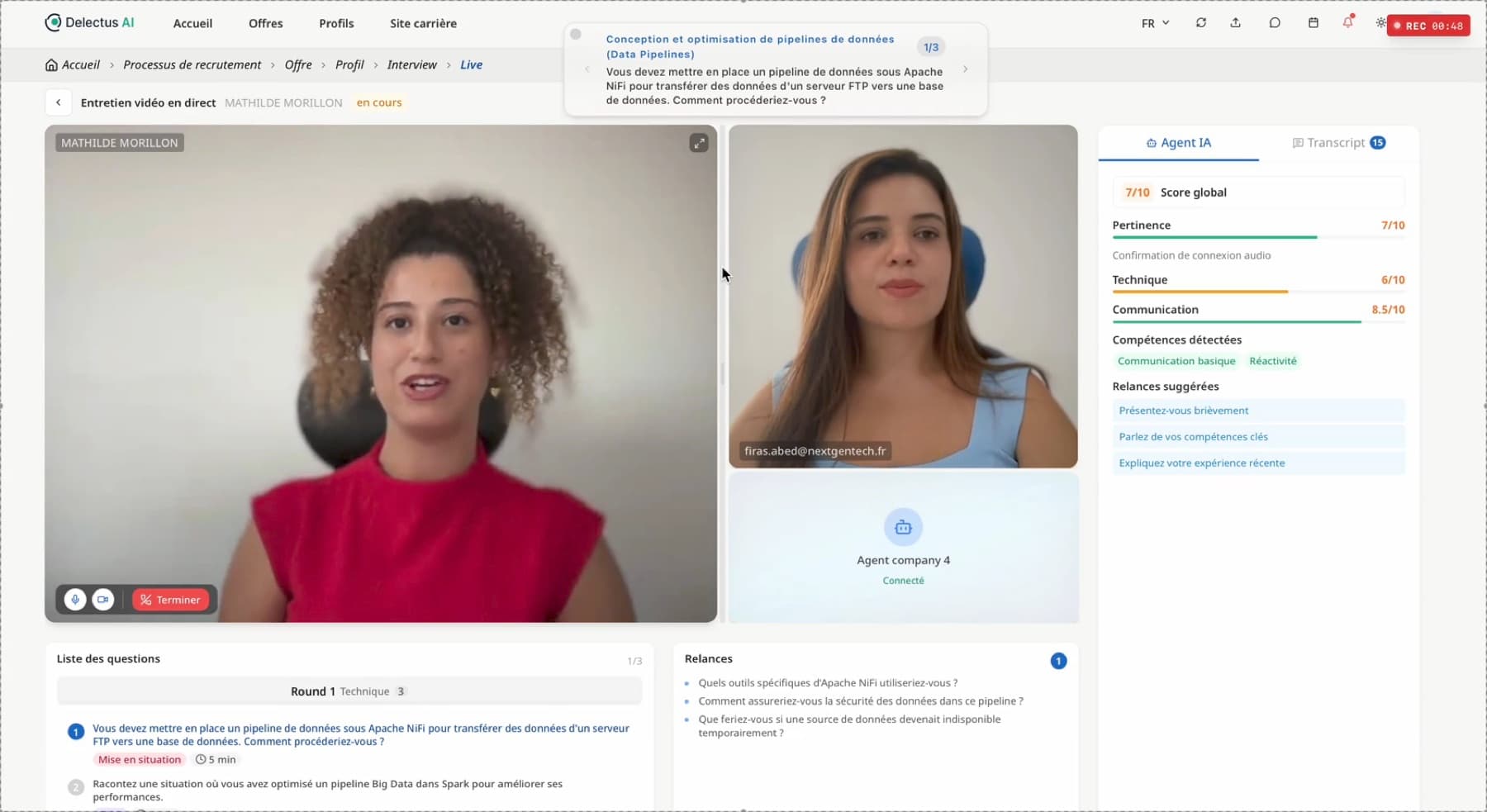
What makes an interview hard to use afterward
- Listening and writing at the same time. While you're typing, you're only half listening, and the right follow-up comes too late.
- A flow that changes every time. Depending on the vibe, you rush one topic or linger on another, and candidates stop being comparable.
- Notes written up too late. That evening or the next day, all that's left is a general impression and a few scribbled words.
How a structured interview flows
- Welcome and framing, 5 minutes. Walk through the agenda and the length, and tell the candidate when they'll be able to ask their questions.
- Background, 10 minutes. The candidate summarizes the experience that matters for this role, not their whole career.
- Skills questions, 30 minutes. Ask everyone the same questions about things they've actually done, and follow up until you get examples.
- Candidate questions and next steps, 15 minutes. Answer honestly and give the date of the next step.
Sample structured interview plan
Here's the plan for a one-hour interview for a recruiter role. The main questions are the same for every candidate; the follow-ups depend on their answers.
| Time | What you're assessing | Main question | Follow-up |
|---|---|---|---|
| 0–5 min | Welcome | Walk-through of the agenda and the people present | “Any questions before we start?” |
| 5–15 min | Background | “Which experiences prepare you best for this role?” | “What did you learn in that job?” |
| 15–25 min | Sourcing | “Tell me about a hard-to-fill role you worked on.” | “Which channels got results?” |
| 25–35 min | Working with hiring managers | “Tell me about a disagreement with a hiring manager over a candidate.” | “How was the decision made?” |
| 35–45 min | Organization | “How do you handle fifteen or so open roles at once?” | “What do you do when everything becomes urgent?” |
| 45–60 min | Candidate questions and next steps | “What questions do you have about the role?” | Outline of next steps and when they'll hear back |
Adapt the areas and questions to your role. In Delectus, this plan is prepared from the job posting.
Structured vs. unstructured interviews: what changes
In an unstructured interview, the conversation follows wherever the answers lead. It's pleasant, but every candidate gets a different interview, and when it's time to compare, all you have left are impressions.
In a structured interview, the main questions, their order and the scorecard are set before the first meeting. You're still free to follow up as you like. Every candidate for the role is judged on the same basis, which makes the decision fairer and far easier to explain, to the hiring manager and to the candidate.
How to conduct a structured interview, step by step
The method comes down to five steps, repeated for each role.
- Agree with the hiring manager on four to six evaluation areas drawn from the role's responsibilities
- Write one main question per area, and what a good answer should include
- Set the rating scale and describe each level with examples
- Run every interview in the same order, following up to get facts
- Score each area right after the interview, before discussing it with the other interviewers
Preparing for an interview
A good interview is won before it starts. Reread the job posting and the scorecard criteria, then the candidate's resume, noting the two or three points to dig into. Prepare your main questions with their follow-ups. Book a quiet room or test the video link, and keep fifteen minutes after the interview to write your notes.
In Delectus, most of that prep is already done. The role's interview kit already holds the questions and scoring criteria, and the candidate profile brings together their AI summary, prescreening answers, notice period and salary expectations. The meeting is booked from the built-in calendar, synced with Outlook and Teams, and the candidate picks from the time slots offered.
Following up with the STAR method
Many candidates open with a general answer, something like “I'm generally pretty organized.” The STAR method helps bring things back to facts. Ask first for the situation (“Can you give me a specific example?”), then the task (“What was your exact role?”), the action (“And what did you do?”) and finally the result (“How did it turn out?”).
A complete answer covers all four. If one is missing, follow up once. If it's still missing, note it on the scorecard rather than filling the gap yourself.
The most common mistakes
Even with a good scorecard, a few traps come up again and again.
- Making up your mind in the first few minutes, then looking for confirmation
- Talking more than the candidate
- Asking closed questions that can be answered with yes or no
- Scoring from memory, hours later
Training hiring managers to interview
Hiring managers don't hire often, and it shows in their interviews. A few rules make a big difference. Stick to the role's question kit instead of improvising new questions along the way. Let the candidate talk at least two thirds of the time and ask for a concrete example every time. And fill in the scorecard right after, before comparing notes with the other interviewers.
The shared kit helps a lot. A manager interviewing a candidate for the first time has the same questions and criteria in front of them as the recruiter, and their scores compare directly.
Structured interviews over video: what changes
Over video, the flow stays the same, but a few precautions matter. Send the link and the names of the participants in advance, check the audio right at the start and mention that a note-taking tool is present. Also leave a short pause after each question, because people talk over each other more easily than in person.
The interview agent during a structured interview
The video interview runs right in the platform. Both participants are told the agent is there. It transcribes the conversation in real time and suggests follow-up questions when an answer lacks facts. You keep your eyes on the candidate instead of your keyboard.
Each answer is tied to its question in the kit and gets a score. At the end, the interview report is written automatically. It includes an evaluation per criterion, each score backed by the candidate's own words, and an analysis by theme: technical skills, soft skills and motivation. You approve it or correct it; the decision stays yours. The recording lets you replay a passage before the debrief.
Frequently asked questions
What is a structured interview?
An interview whose questions, order and scorecard are set in advance and are the same for every candidate for a given role. Candidates become comparable, and bias has less room to creep in.
How long should an interview last?
An hour works well for a first in-depth interview. That's enough for five or six questions with their follow-ups, and to let the candidate ask their own.
Does the candidate need to be told an AI is taking notes?
Yes. With Delectus, the agent's presence is announced to both sides at the start of the interview.
What are the stages of a job interview?
It starts with a welcome and a walk-through of the agenda. The candidate then presents their background, followed by the skills questions. It ends with their questions and an outline of next steps.
What is the STAR method in an interview?
STAR stands for Situation, Task, Action, Result. The interviewer has the candidate describe a real situation, what they had to do, what they did and what came of it.
How many questions should a structured interview have?
Five or six main questions for an hour, each with two or three follow-ups. Beyond that, you won't have time to get specific examples.
Can you go off script during a structured interview?
For follow-ups, yes: they follow the candidate's answers. The main questions, however, stay the same for every candidate for the role.