Where hiring loses time
- Applications read too late. Resumes pile up while the team handles emergencies. By the time someone opens them, the best candidates have sometimes already accepted another offer.
- Back-to-back prescreening calls. It's always the same questions about availability, salary or willingness to relocate, asked over the phone between two meetings.
- Interviews that are hard to compare. Every recruiter has their own questions and their own way of taking notes. When it's time to decide, you end up comparing impressions.
From job brief to interview, how it works
- You describe the role. One brief drives every agent. It lists the skills you need, the knockout criteria and the questions to ask candidates.
- Every application is read as it arrives. The AI compares the resume to the role and explains its ranking. It also searches your candidate database for people you've already met.
- Candidates are prescreened. The agent reaches them by phone, text or WhatsApp, asks your questions and files their answers in the candidate profile.
- Interviews are prepared and evaluated. You go in with a question kit tailored to the role. During the conversation everything is transcribed, and a structured evaluation is waiting for you at the end.
What AI recruiting software does, task by task
The tasks in a hiring process, and who handles them depending on the tool.
| Task | Traditional recruiting software | Delectus |
|---|---|---|
| Receive and organize applications | Yes | Yes, or through your ATS |
| Read and rank resumes | The recruiter | The AI, with the reasons for its ranking |
| Find past candidates | Keyword search | Search by meaning, for every new role |
| Prescreen candidates | The recruiter, by phone | The SMS prescreening agent and the voice prescreening agent |
| Prepare interview questions | The recruiter | A question kit for each role |
| Write the interview summary | The recruiter | Transcript and evaluation by criterion |
| Decide | The recruiter | The recruiter |
What is AI recruiting software?
Traditional recruiting software organizes the work. It centralizes job openings and applications and shows where each candidate stands. Screening resumes, making calls and writing interview summaries are still done by hand, often in the evening, once the calendar finally clears.
AI recruiting software takes part of that work off your plate. At Delectus, it does so with agents. An agent completes an entire task from your instructions: it reads an application the moment it arrives, calls a candidate at the scheduled time, or writes the summary when the interview ends. Each one has a clear scope, and they all follow the same job brief.
A week of hiring with AI agents
Say you post a field sales opening on a Friday. On Monday morning, the weekend's applications have already been read and ranked, each with the reasons behind its ranking. You skim the top of the list, glance at a few profiles further down, then launch prescreening for the ones you like.
During the day, the SMS agent texts those candidates. Those who don't answer get two follow-ups, then a call from the voice agent. By the end of the week, interviews are booked into your open slots, and for every candidate you have their answers and a ready-made question kit. Your time went into reading profiles and running interviews.
What you'll use in the software every day
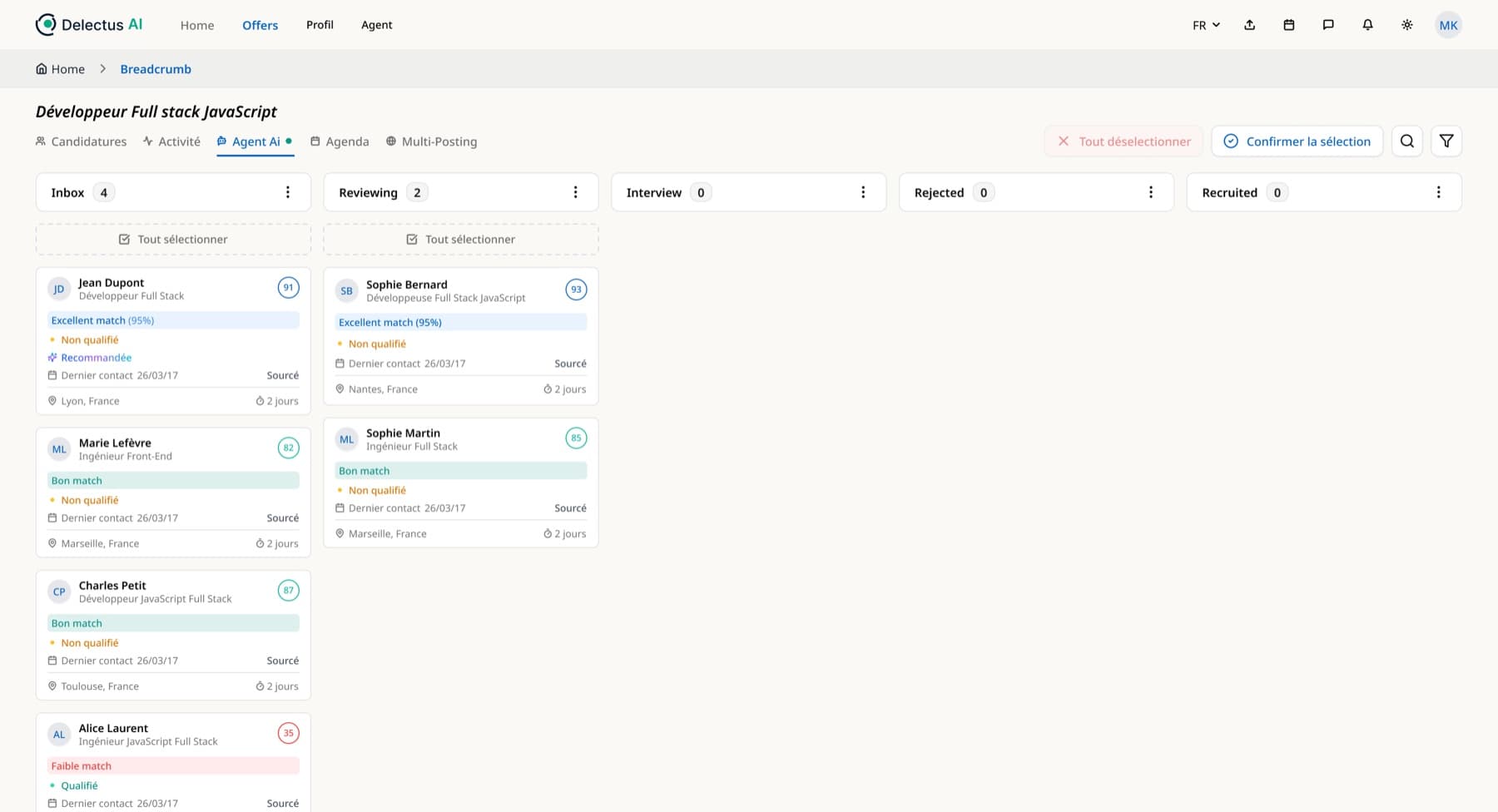
Each job opening has its own kanban pipeline. Candidates move from one column to the next, and each candidate profile brings together the parsed resume, a summary of strengths and gaps, your notes, your tags, expected salary, notice period and the full history of every exchange. Have a question about a candidate? Ask the AI chat, which answers from the resume and the conversations.
The built-in calendar syncs with Outlook and Teams. When the agent offers a candidate a meeting, it works from your actual free slots. You're notified as soon as a candidate replies, and you can assign a task to a colleague without leaving the profile.
Video interviews happen inside the platform. The transcript appears in real time, the agent suggests follow-up questions, and the analysis is broken down by theme: technical skills, soft skills and motivation. The interview is recorded so you can watch it again, and the report writes itself.
Rankings you can check
A ranking with no explanation isn't worth much. You don't know whether to trust it or how to defend it to a hiring manager. So every recommendation comes with what supports it, whether that's a skill found in the resume, an answer given during prescreening or a specific moment in the interview.
The AI doesn't reject anyone. A candidate ranked low stays on the list, and you can always move them forward if their background speaks to you.
The voice and SMS prescreening agents
Prescreening is often where things get stuck. Two agents handle it. The SMS prescreening agent texts the candidate first, introduces itself as an AI and asks for their consent before asking the job's questions. If the answers fit, it offers a meeting in your open slots right away.
The voice prescreening agent takes over by phone, at the time agreed with the candidate or when texts go unanswered. It holds a real conversation, follows up when an answer is vague, then fills in the candidate profile. All you have to do is read and call back the candidates you're interested in.
Connected to your tools, or used on its own
Delectus connects to most ATSs on the market and pulls in your job openings, applications and resumes. The connection is read-only: nothing is changed in your ATS, and your team finds the agents' work in Delectus. If you don't have an ATS, the software manages job openings, applications and tracking itself.
To get started, don't open everything at once. Connect your ATS or import your job openings and resumes, then describe a first role with its criteria. Look closely at the first rankings and rework the criteria if they don't say exactly what you're looking for. Once prescreening and the interview kit are validated on that role, move on to your other openings.
Who is AI recruiting software for?
Expectations differ depending on who's hiring.
- In a small business with no HR team, the owner or a manager does the hiring on top of their day job
- An in-house recruiting team handles a large volume of applications for several roles at once
- An IT consulting firm has to answer a client's request fast, with the right consultants and an up-to-date consultant profile
- A recruitment agency lives on the quality of its shortlist and on being faster than competing agencies
How to choose recruiting software
Recruiting software should be judged on the time it gives back to the team; the feature list says very little. Before comparing tools, pinpoint the steps where your hiring loses days. For some teams it's screening applications. For others, it's candidates they can't reach, or interview summaries that drag on.
Then look at what the tool actually does without you, how it explains its results, and how it connects to your ATS, email and calendar. Data hosting matters too, as does how long it takes a team that recruits on top of its day job to get up to speed. During a demo, ask concrete questions, on your own job openings if possible.
- "Can you show me why this candidate is ranked first?"
- "What happens to a candidate the AI ranks poorly? Who sees them?"
- "Where is candidate data hosted, and is it used to train a model?"
- "How does the candidate know they're talking to an AI?"
- "What do we need to change in our current tools to get started?"
AI recruiting software and the EU AI Act
The European Union's regulation on artificial intelligence classifies AI systems used to recruit or evaluate candidates as high-risk systems. Among other things, it requires human oversight, informing the people concerned, and documenting the system.
In practice, AI recruiting software must leave the decision to a human, explain its results and let you check them. Delectus is built that way. The recruitment guide published by the CNIL, France's data protection authority, also sets out the GDPR rules that apply to every application, with or without AI.
Frequently asked questions
What is AI recruiting software?
It's software that uses artificial intelligence to handle the repetitive steps of hiring, such as reading resumes, prescreening candidates or writing interview summaries. At Delectus, agents do this by following the brief you wrote for the role.
Does the AI make the hiring decision?
No. It ranks, summarizes and evaluates, and gives its reasons. The choice belongs to the recruiter and the hiring manager.
Do I need to switch ATS to use Delectus?
No. It connects to your ATS in read-only mode and pulls in your job openings and applications without changing anything there. If you don't have an ATS, you can also use it on its own.
Do candidates know they're talking to an AI?
Yes. Every call, every text conversation and every interview run by an agent is disclosed as automated.
What is the best recruiting software?
The one that fixes the steps where your hiring slows down. A small business short on time to screen resumes doesn't have the same needs as an agency that has to put candidates in front of clients fast. The most telling test is to try the tools on your own job openings.
How much does recruiting software cost?
Prices vary with the number of users, job openings or candidates processed. On pricing, the demo is where we put together a proposal that fits your volume.
What's the difference between an ATS and AI recruiting software?
An ATS tracks applications and their progress. AI recruiting software does part of the work itself, by reading resumes, reaching out to candidates and preparing interviews. Delectus can run on its own or alongside your ATS, pulling in its job openings and applications.
Is AI recruiting software GDPR compliant?
It can be, if it follows GDPR principles: a clear purpose, informing candidates, defined retention periods and protected data. With Delectus, data is hosted in the European Union and isn't used to train any model.