Why interview questions so often fall flat
- Questions that are too broad. Ask “What are your strengths?” and you'll get an answer rehearsed the night before. It tells you nothing about how they work.
- Questions that change from one candidate to the next. Without a shared list, every interview follows the mood of the moment. When it's time to decide, you're comparing conversations that have nothing in common.
- No way to judge the answer. Knowing what to ask isn't enough. You also need to know what separates a convincing answer from one that just sounds good.
Building your question set
- List the skills the role needs. Start from the responsibilities and keep four to six skills. “Energetic” or “detail-oriented” won't help you choose between two candidates.
- Ask about past facts. Prefer “Tell me about a time when…” to “What would you do if…”. A real experience can be probed; a hypothetical gets recited.
- Plan your follow-ups. Write down two or three follow-ups per question, to pin down the candidate's exact role, the result they got or what they'd do differently.
- Write down the expected answer. For each question, note what a good answer should include. While you listen, all that's left is to check it off.
Interview questions sorted by skill
Adapt these behavioral questions to your role. The last column sums up what to expect from a solid answer.
| Skill | Question | A good answer includes |
|---|---|---|
| Technical expertise | Describe a recent project you're proud of. What was your exact role? | A specific context, technical choices with reasons, a measurable result |
| Problem solving | Tell me about a problem you couldn't crack. How did you get past it? | An approach, hypotheses tested, what finally worked |
| Teamwork | Tell me about a disagreement with a coworker over how to do the work. | Listening to the other side, a compromise or a decision that was explained |
| Organization | How did you handle a stretch when several urgent things hit at once? | Explicit priorities, what was delegated or pushed back, and why |
| Communication | Explain something from your field the way you would to a non-expert client. | Plain language, a concrete example, a check that the other person understood |
| Learning | What's the last skill you taught yourself? How did you do it? | An active approach, sources named, putting it into practice |
| Motivation | What made you apply for this role rather than another one? | Reasons specific to the role and the company, consistent with their background |
For a one-hour interview, five or six questions are enough. That's the time it takes to follow up and get specific examples.
Common job interview questions, and how to make them better
Classic questions share one flaw. Candidates have read them everywhere, and their answer is ready before you've finished asking. A small rewording is often enough to bring things back to facts.
- “Tell me about yourself” becomes “Which experiences in your background prepare you best for this role?”
- “What's your biggest weakness?” becomes “What skill have you had to work on recently, and how did you go about it?”
- “Why should we hire you?” becomes “What would you bring in your first three months?”
- “Where do you see yourself in five years?” becomes “What would you like to learn in this role?”
- “Do you handle stress well?” becomes “Tell me about a tense situation at work and what you did.”
Behavioral interview questions: examples and follow-ups
A behavioral question asks the candidate to describe a situation they actually went through. The idea is simple: how someone acted in the past says more than what they promise to do tomorrow.
What makes these questions work is the follow-up. Without it, the candidate sticks to a clean, general version of the story. Here are a few questions with the follow-ups that force them into the details.
- “Tell me about a time a project fell behind. What did you do?” Follow-ups: “Who did you tell, and when?”, “What would you do differently today?”
- “Tell me about a disagreement with a coworker or a manager.” Follow-ups: “How did you present your point of view?”, “How did it end?”
- “Describe something you had to learn quickly.” Follow-ups: “Where did you start?”, “How long did it take you to work on your own?”
- “Tell me about a mistake you made at work.” Follow-ups: “How did you find out about it?”, “What did you put in place so it wouldn't happen again?”
Situational interview questions: when to use them
A situational question describes a made-up case and asks the candidate how they'd handle it. It's useful with junior candidates who haven't lived the situation yet, and for roles where method matters more than experience.
For a customer service rep, for example: “A customer calls, upset about a late delivery for the second time. They're threatening to cancel. How do you handle the call?” A good answer talks about listening, acknowledges the problem, offers a concrete fix and plans a follow-up. Write these expectations down before the interviews, or each candidate will be scored on a different basis.
Interview questions by profile: managers, sales, entry-level
For a management role, get the candidate talking about real management. Ask them to describe a tough decision they made for their team, how they supported a struggling team member, or a hire they made and what they'd do differently looking back. “How do you set your team's priorities when everything is urgent?” also gets very revealing answers.
With a salesperson, the method matters as much as the numbers. Have them describe their best deal and how they found it, then a deal they lost and what they took from it. Ask how they organize their prospecting over a week, and what they say to a customer who thinks the price is too high.
For an entry-level job or an internship, look for facts outside work experience. A school or personal project they're proud of, a group project that went badly, what they took from a student job: all of it can be probed exactly the same way. Ask them too how they get organized when several deadlines land in the same week.
How to evaluate an answer to an interview question
Judge the content of the answer and set aside how smooth the candidate is. Four markers are enough. Is the situation real and specific? Does the candidate say “I”, or hide behind “we”? Does the action they describe fit the role? Is the result explained, even when it's mixed?
Score the answer right after the question, with a sentence from the candidate that backs up the score. If you wait until the end of the interview, the answers blur together and the score ends up reflecting your overall impression.
Interview questions in the Delectus interview kit
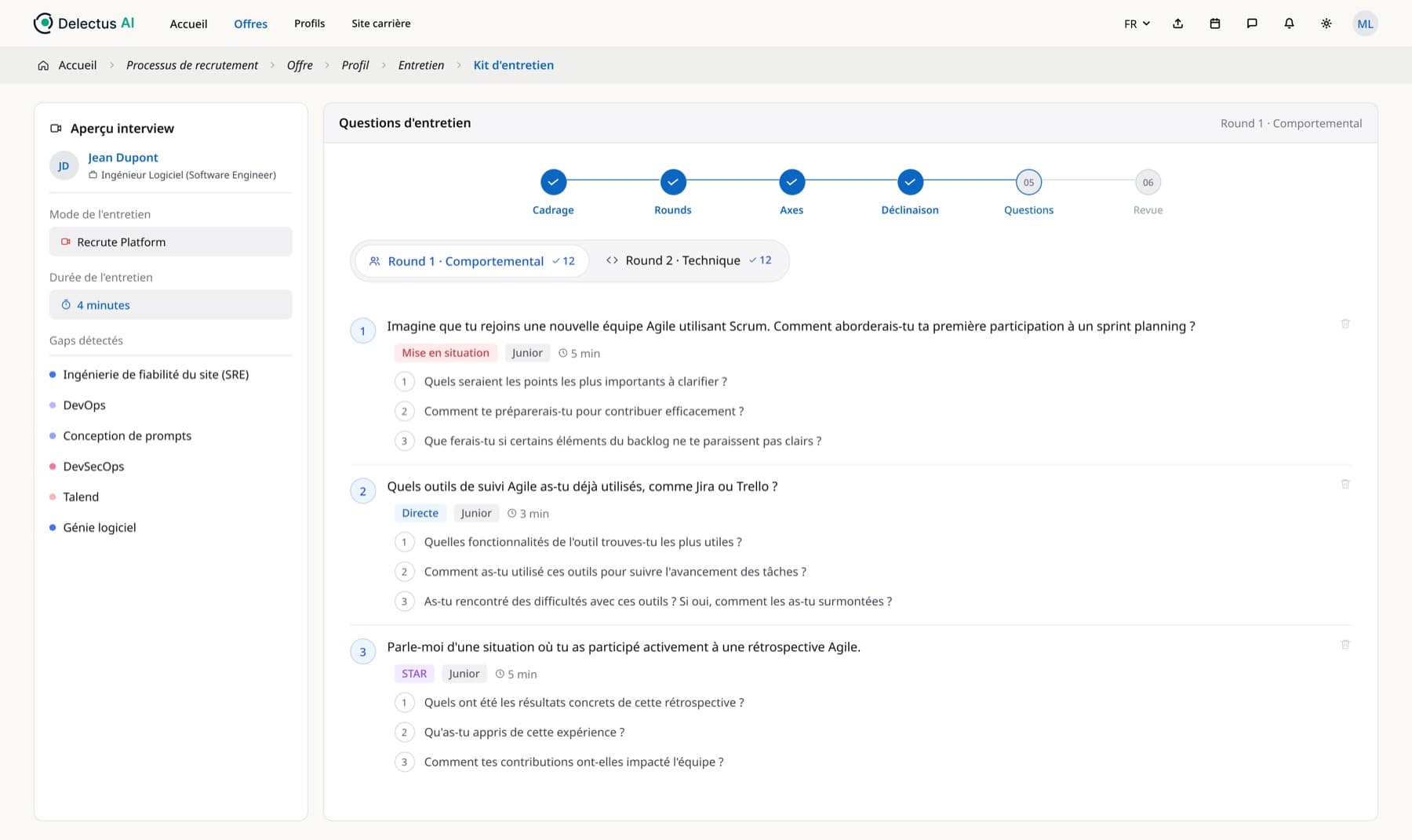
In Delectus, you don't start your questions from a blank page. The interview kit is built from the job posting. It holds the areas to assess, the questions for each one and the scoring criteria, meaning what a good answer should include. You edit whatever you like, and the kit becomes the reference for every interview for that role.
During a video interview run in the platform, the conversation is transcribed in real time and the agent suggests follow-ups when an answer stays vague. Each answer is tied to its question and scored question by question. The end-of-interview report groups the analysis by theme: technical skills, soft skills and motivation. Comparing two candidates on the same question becomes simple, and the recording lets you replay a passage when in doubt.
Frequently asked questions
What questions should you ask in a job interview?
Questions about situations the candidate actually went through, tied to the skills the role needs. A project they ran, a problem they solved or a disagreement with a coworker tells you far more than the strengths they claim.
How many questions should you plan for an interview?
Plan five or six main questions for an hour, follow-ups included. With more, you won't have time to get specific examples.
Which interview questions are off-limits?
Anything touching a protected characteristic, such as family status, pregnancy plans, national origin, religion, political views, health or union membership. Your questions should be about the ability to do the job.
Should you ask every candidate the same questions?
Yes for the main questions, otherwise you can't compare candidates for the same role. Follow-ups, on the other hand, follow each person's answers.
What are the most common job interview questions?
Walking through their background, motivation, strengths and weaknesses, a success and a failure, teamwork and salary expectations. You'll get better answers by turning them toward real situations.
What should you ask at the end of an interview?
Always leave the candidate time to ask their own questions, then explain the next step and when they'll hear back. The questions they ask often say a lot about their motivation.
What is a behavioral interview question?
A question that has the candidate describe a real situation from their career, what they did in it and how it turned out. You get facts, where a general question only gets you intentions.
Should you ask trick questions in an interview?
They rarely teach you anything useful about the skills the role needs, and the candidate walks away with a bad memory of the interview. A well-probed behavioral question will tell you more.