Why interview summaries are often weak
- Written from memory. Written after three or four interviews in a day, they mix candidates up and lose the details.
- Too short to decide on. “Good profile, revisit” doesn't help the hiring manager choose between two finalists.
- Disconnected from the role's criteria. Everyone writes their own way, without going back to the scorecard set at the start.
How Delectus produces the summary
- The interview is transcribed. Word for word and in real time, telling apart what the recruiter says from what the candidate says.
- Answers are tied to the criteria. Each useful passage is linked to the question and the interview kit area it speaks to.
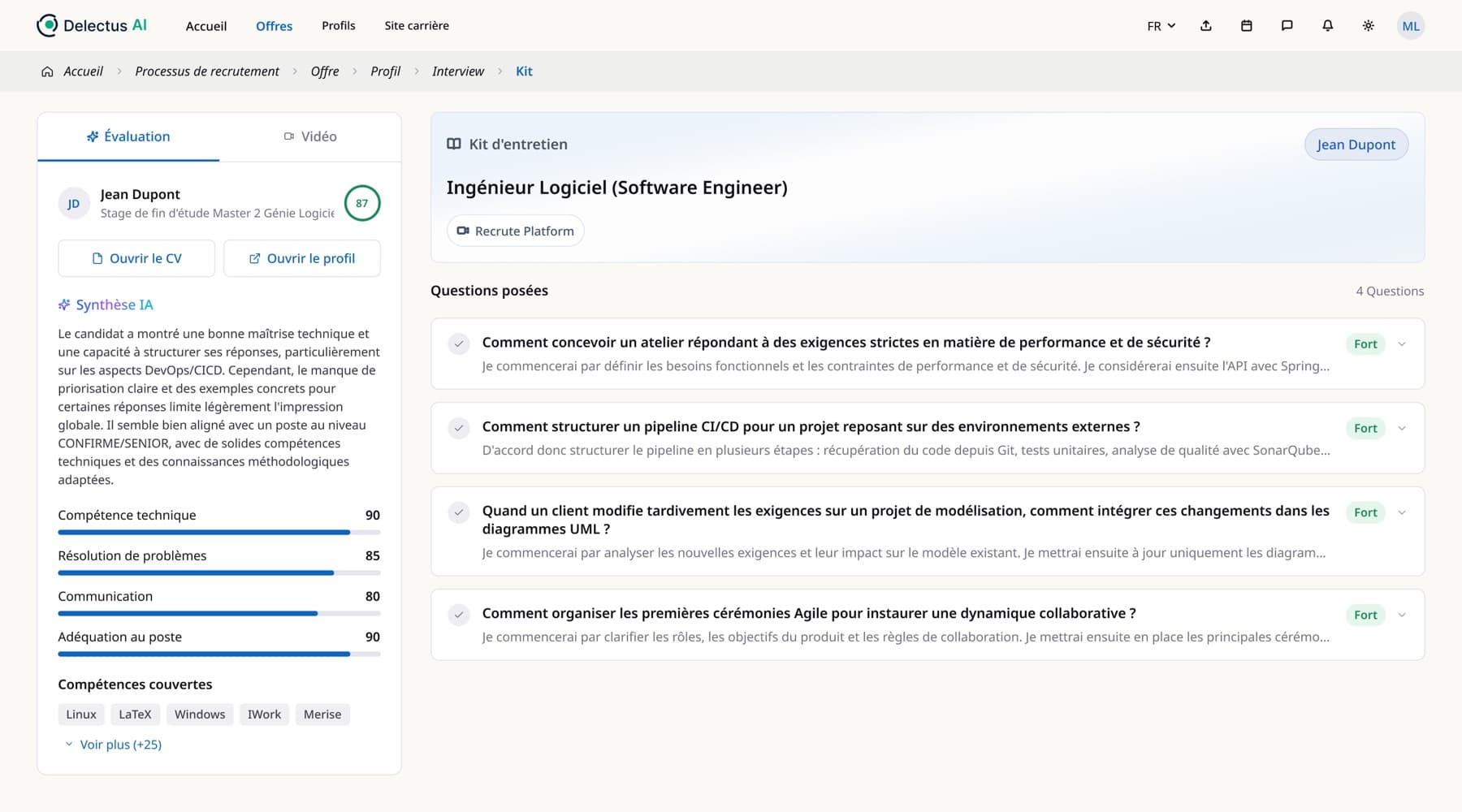
- A draft summary is proposed. Overview, evaluation per criterion with quotes, points to verify. You review it, correct it if needed and approve it.
The sections of an interview summary
The structure we recommend, and the one Delectus fills in from the interview.
| Section | Content | Example |
|---|---|---|
| Overview | Three lines: the profile and the recommendation | “Strong on architecture, needs confirming on people management. Recommended for the second round.” |
| Evaluation per criterion | One score per scorecard criterion, with the reason | “Problem solving: 4/5 — described migrating a production database with no downtime.” |
| Strengths | What sets the candidate apart for this role | Direct industry experience, examples with numbers |
| Watch points | What still needs checking | Little experience managing a team |
| Logistics | Availability, compensation, relocation | Available in two months, open to relocating |
How to write an interview summary, step by step
The summary starts during the interview. Write down the facts and a few of the candidate's exact words, without judging them on the spot. Right after, score each scorecard criterion with the sentence that backs up the score. Then write the overview in three or four lines, followed by the recommendation. Finish with the points to check in the next round or during reference checks.
The reading order isn't the writing order. The hiring manager reads the recommendation first, so it goes at the top of the document, even if it's the last thing you write.
Interview summary template you can reuse
This outline works for most roles and can be copied as is into the tool you already use.
- Header: role, candidate name, date, interviewers present, interview round
- Recommendation: move forward, discuss or don't move forward, in one sentence
- Overview: three or four lines on fit with the role
- Evaluation per criterion: score, reason, quote from the candidate
- Watch points: what still needs checking
- Logistics: availability, expected compensation, relocation
- Proposed next step: next interview, references, reply to the candidate
Interview summary example
“Candidate for the back-end developer role. Recommended for the second round. Strong on API design: described rebuilding a payment service, with well-reasoned caching choices and response times cut in half. Less management experience, has never supervised an intern. Available in two months, salary expectations within range. To check in the second round: autonomy on production deployments.”
The example fits in a few lines, but every statement rests on something the candidate described during the interview. That's exactly what makes it useful to the hiring manager, who can read it in two minutes and know what to dig into.
Keeping an interview summary factual
Candidates have the right to access the information held about them, so they may read your summary. Write it with that in mind. Describe what was said and demonstrated, and leave out judgments about the person.
Instead of “not very dynamic” or “lacks charisma”, write something like “gave no example of a project led independently.” And never mention anything related to age, family status, national origin or health.
Interview summary mistakes to avoid
A few flaws come up often and make the summary hard to use.
- An overview with no recommendation, leaving the hiring manager to guess what the recruiter thinks
- Scores with no reasons, impossible to compare from one candidate to the next
- A chronological account of the interview instead of an evaluation per criterion
- Remarks about the person rather than about what they said or demonstrated
- A summary sent several days later, when memories have started to blur
Sharing the summary with the hiring manager
The summary exists so several people can decide together. Shared with the hiring manager before the decision meeting, it lets everyone compare candidates on the same criteria and spend the meeting only on the points they disagree on.
In Delectus, the interview report is attached to the candidate profile. The hiring manager also finds the profile's AI summary, the team's notes and the activity history there. To check a passage, they replay the recording instead of asking the recruiter what the candidate really said. A task can be assigned to them to give their opinion, and they're notified as soon as the report is ready.
The interview summary and candidate feedback
A factual summary also makes it easier to get back to the candidate. If they aren't selected, the criteria they didn't meet give precise, respectful feedback, for example “For this role, we were looking for more hands-on experience managing a budget.” The candidate gets something out of it, and the company stands behind its decision more easily than with a stock phrase.
An interview summary drafted from the transcript
With Delectus, the report is written automatically at the end of the video interview, from the transcript. Every score is backed by something the candidate said, and the analysis by theme separates technical skills, soft skills and motivation. The hiring manager sees what was said, not just what the recruiter thought of it. The recruiter reviews, adjusts and approves before sharing.
Frequently asked questions
What should an interview summary include?
A recommendation, a short overview, an evaluation against each of the role's criteria, strengths and watch points, then the candidate's practical details.
When should you write the interview summary?
Right after the interview, while the answers are fresh. With Delectus, a draft is ready as soon as the conversation ends, built from the transcript.
Can a candidate ask for their interview summary?
Under the GDPR, a candidate can request access to the data held about them, including the evaluations made about them.
How do you write a job interview summary?
Start with the recommendation, then evaluate each of the role's criteria with a fact quoted from the interview. Finish with the watch points and the practical details, staying factual from start to finish.
Should you keep summaries for candidates you didn't hire?
They follow the retention rules for application data. The CNIL (France's data protection authority) recommends not keeping them longer than two years after the last contact with the candidate.
How long should an interview summary be?
One page is usually enough, with a recommendation, a few lines of overview and a short evaluation per criterion. The hiring manager should be able to read it in two minutes.
Who writes the summary when several people interview the candidate?
Each interviewer fills in their own scorecard, then one person writes the shared summary after the debrief. Differences in scores stay visible in the summary.