What slows down recruiting at an IT consulting firm
- A client request to fill in a few days. Whoever submits a strong profile first often wins the project.
- Technical profiles that are hard to judge. Account managers have to assess specialized skills without being experts themselves.
- A scattered talent pool. Candidates, consultants on assignment and former employees live in several files that don't talk to each other.
From client request to consultant submitted
- The request becomes a search. You enter the project brief and Delectus ranks the matching profiles in your database, consultants and candidates alike.
- Profiles are prescreened. Availability, daily rate or salary, willingness to travel: the agent checks before you ever pick up the phone.
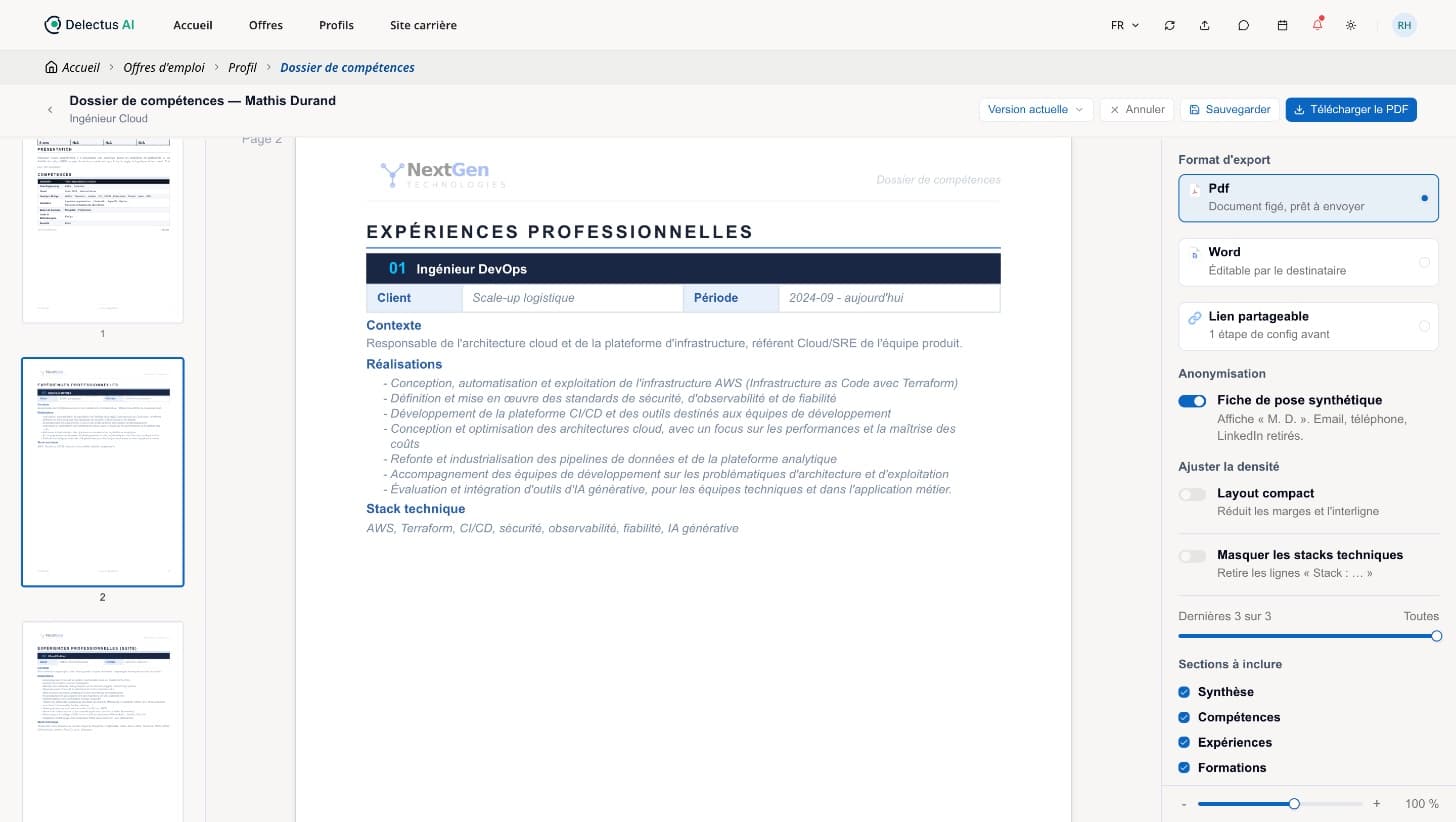
- The consultant profile is generated. In the firm's format, focused on the project.
- The consultant is prepared. An AI mock client interview, and a report to improve on.
IT consulting recruitment: without and with Delectus
What changes, step by step, for the recruiting team and the account managers.
| Step | Without Delectus | With Delectus |
|---|---|---|
| Talent pool search | Keyword search | Consultants and past candidates suggested with the reasons |
| Prescreening | Calls one by one | Availability, daily rate and travel collected by the agent |
| Technical interview | Handwritten notes | Question kit, transcription, scoring |
| Consultant profile | Reformatted for every submission | Profile generated in the firm's format |
| Client interview | Verbal briefing | Briefing and mock client interview |
The IT consulting recruitment process, step by step
It all starts with a client request, or a forecast of one. You search the talent pool first (available consultants, past candidates, referrals), then prescreen the shortlisted profiles on availability, pay or daily rate, and willingness to travel. Next come a technical interview and an interview with the account manager, writing the consultant profile, submitting it to the client, and finally the client interview that leads to the hire or the start of the assignment.
Every step takes time, but not the same kind. Searching the talent pool, prescreening and formatting the profile repeat from one request to the next. That's where the tool saves the most. Technical interviews and the client relationship stay with the team, which comes to them better prepared.
Finding the right profile in your talent pool
In Delectus, consultants on assignment, past candidates and new applicants sit in a single database. Each resume is read by the AI and turned into a structured profile, with experience, skills and years of practice. So you can search by more than keywords.
You can enter the project brief and let the tool rank profiles, with a score and the reasons for the ranking. You can also filter by experience, skill or location, or ask in natural language: “Java developers with banking experience, in the Paris region, available within a month.” Past candidates who match a new project surface on their own.
Evaluating a technical profile without being an expert
An account manager doesn't need to master every technology. What they need are questions that get candidates to describe concrete situations, and markers for what a good answer contains.
Example for a back-end developer: “Describe the last API you designed. How many users, what performance constraints, what choices did you make?” A solid answer mentions volumes, reasoned choices and the limits they hit. The interview kit prepares these questions and markers for each project.
For a first look at a profile, the AI summary sums up its strengths and gaps against the request. And if a question comes to mind, you ask it directly about the profile in the chat (“Have they worked in a regulated environment?”); the answer draws on their resume and past conversations.
Prescreening your candidates and consultants by text or phone
On a client request, you need to know fast who's free, at what daily rate or salary, and how far they can travel. The SMS prescreening agent sends a first message in which it introduces itself as an AI and asks for the candidate's consent. It then asks the posting's questions in a real conversation, flags answers that contradict each other and fills in the candidate profile.
With no reply after two follow-ups, the voice prescreening agent takes over and calls. If the candidate stays unreachable, the recruiter is alerted. You get a notification as soon as a profile replies, and the agent can offer an interview slot straight from your Outlook or Teams calendar.
Prescreening questions for an IT consulting firm
These are the questions the agent asks for you, and you can adjust them for each request.
- “Are you currently employed, and what's your notice period?”
- “Would you prefer a permanent position with a consulting firm or a freelance assignment?”
- “What are your salary expectations, or your daily rate if you're independent?”
- “How far are you willing to travel, and how many days on site?”
- “Are you in other hiring processes right now?”
Running the technical interview on video
The interview can be held on video right in the platform. During the conversation, the transcript appears in real time and the tool suggests follow-ups when a theme from the kit hasn't come up yet. At the end, a report sorts the answers by theme, and the recording stays available to replay.
An account manager who wasn't in the technical interview can read what the candidate said about the skill they care about, instead of relying on a three-line note.
Hiring for a profile or for a project?
An IT consulting firm hires in two ways. For a project, to meet a specific client request: the candidate is hired to start at that client. For a profile, ahead of demand: you hire in-demand profiles you'll place on upcoming requests.
The first is fast but depends on the client's decision. The second requires knowing your market well. Either way, a prescreened talent pool and ready-made profiles shorten the time between the request and the start date, and that's where the shared database and profile generation help most.
From hire to the profile sent to the client
Once the candidate is selected, their consultant profile is generated in the firm's format, from their profile, and geared toward the project. The account manager reviews it, sends it by share link (the client opens it without an account) and can find the version sent later on. Before the meeting, the consultant takes a mock client interview and reads the report.
Each request is tracked in a kanban pipeline, with the notes, tags, salary or daily rate and notice period of each profile. Team members assign each other tasks, and the history keeps a record of every conversation.
Who uses Delectus at an IT consulting firm
The recruiter searches the talent pool and hands prescreening off to the agents. The account manager gets ranked, explained profiles and consultant profiles ready to send. The consultant gets an up-to-date profile and a mock interview before the client interview. Leadership sees which consultants are available and which submissions are in progress.
Choosing a recruiting tool for an IT consulting firm
A standard ATS tracks applications. An IT consulting firm needs something else: a database where candidates and consultants on assignment sit side by side, a search that starts from a project brief rather than keywords, consultant profiles in its own branding, and a way to prepare consultants for the client interview. All without replacing the tools already in place.
Those are the criteria Delectus was built on, with IT consulting firms that use it every day to respond to their clients.
Frequently asked questions
How can an IT consulting firm hire faster?
By starting from your own talent pool for every request, prescreening shortlisted profiles quickly and preparing the consultant profile without rewriting it by hand. Those are the three steps Delectus takes on.
Does Delectus handle consultants already on assignment?
Yes. Their profiles are part of the database and can be suggested for a new project, for example when their current assignment is ending.
Can account managers use it without HR training?
Yes. Rankings and evaluations are explained in plain language, with the parts of the resume or interview that back them up.
What does the hiring process at an IT consulting firm look like?
Usually several stages: a conversation with a recruiter, a technical interview, an interview with an account manager, then an interview with the client when the hire is tied to a project.
How long does hiring at an IT consulting firm take?
From a few days to a few weeks, depending on whether the profile is already in the talent pool or has to be found outside. Against other consulting firms, speed often makes the difference.
What is a daily rate?
The price of one day of the consultant's work billed to the client. It often comes up as early as prescreening.
What's the difference between hiring an employee and a freelancer at an IT consulting firm?
The employee is hired by the consulting firm, which places them on successive assignments. The freelancer works on a specific project, billed at their daily rate. The prescreening questions and the consultant profile are similar in both cases.