What formatting submissions really costs
- Every resume to redo. Resumes come in every format. Putting them into the agency's branding takes time with every submission.
- Clients in a hurry. The client is talking to several agencies. The first one to send a readable shortlist has a head start.
- Confidentiality. Some clients want blind profiles so they can judge the candidate's background before knowing who it is.
How Delectus prepares the candidate submission
- The resume is analyzed. Experience, skills, education and languages are pulled from the resume and organized into a structured profile.
- The submission takes on your branding. Your template and your sections, so every submission looks like the last one.
- You add your take. Your recruiter's assessment, drawn from the interview you ran.
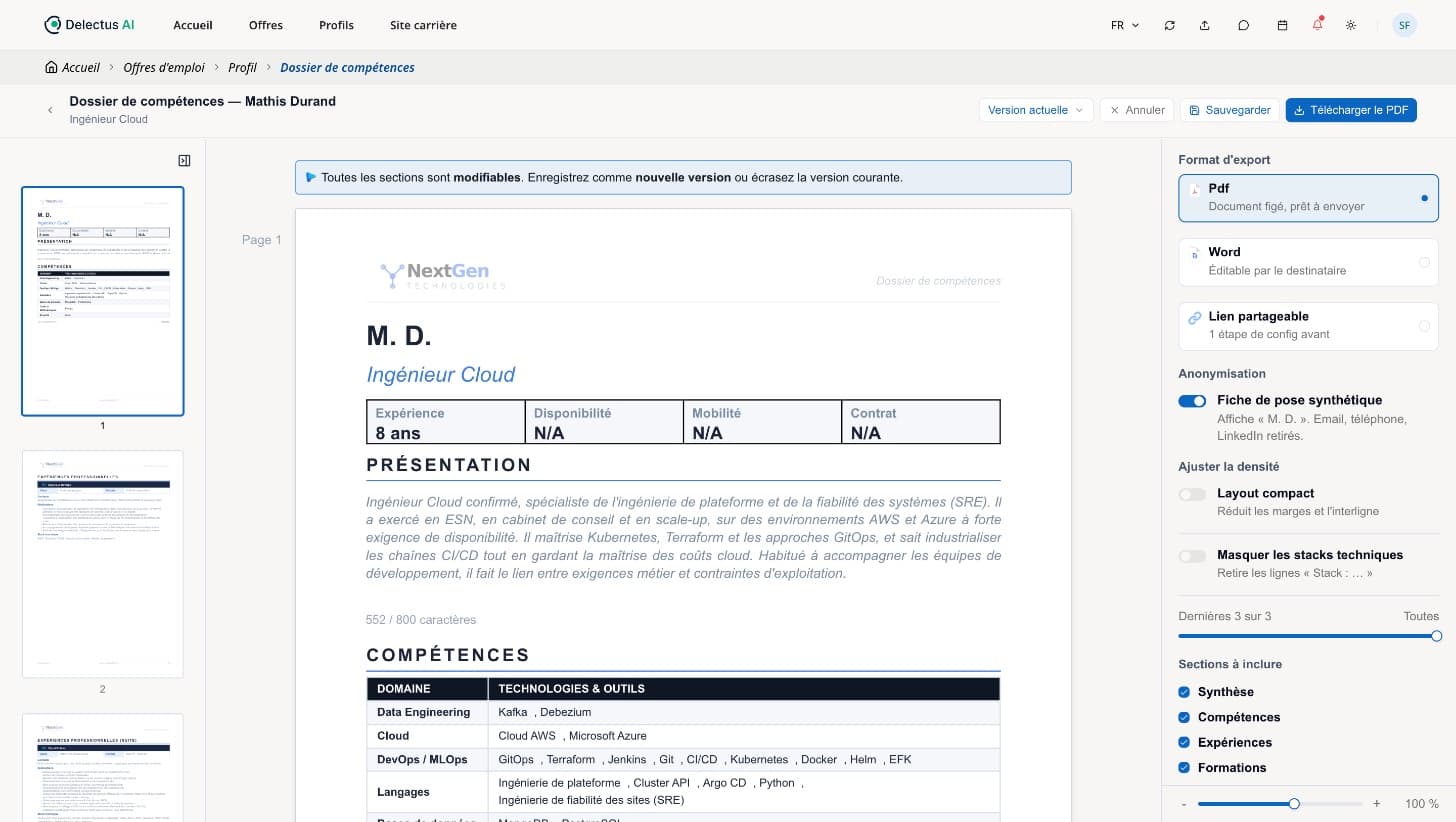
- The client receives it. As a PDF, a Word file or a share link, anonymized if needed.
What a candidate submission should include
The structure most clients expect from a recruitment agency.
| Section | Content | Tip |
|---|---|---|
| Recruiter's assessment | Why this candidate for this role, in a few lines | It's the most-read part: lead with it |
| Background | Recent experience, responsibilities, achievements | Highlight what answers the client's need |
| Key skills | Technical and soft skills | Tie them to the role's criteria |
| Motivation | What the candidate is looking for and why this role | A sentence from the candidate beats a summary |
| Logistics | Availability, compensation, relocation | Avoid surprises at the offer stage |
For a blind profile, also remove details that could identify the candidate: a very specific employer name, overly precise dates.
How do you write a candidate submission for a client?
A candidate submission is written after the interview, never from the resume alone. It opens with the recruiter's assessment: why this candidate is being submitted, what they bring to this role, and what still needs checking. Then come the background, key skills, motivation and finally the logistics (availability, compensation, relocation).
The rule is to answer the questions the client will ask, in the order they'll ask them. Anything that doesn't help them decide can go.
From resume to submission, in Delectus
When the resume comes in, the AI builds a structured profile from it, and that profile feeds the submission in your branding. No more copying dates or putting job titles back in the right order. The candidate's AI summary also suggests their strengths and gaps for the role: a starting point for your own assessment, which you rewrite with what you learned in the interview.
If you ran the interview in the platform, the transcript and the report by theme are right at hand. You can quote what the candidate said about their motivation instead of reconstructing it from memory.
Sample recruiter's assessment
“Selected for direct experience in the role: four years as logistics manager at a warehouse of comparable size, including rolling out a new management system. Comfortable with frontline teams, clear about their results. Point to explore with you: managing a budget of this size. Available within a month, compensation within your range.”
A few lines are enough when every sentence answers one of the client's questions.
Example of a well-written “motivation” section
“Very motivated by the role” tells the client nothing. Write what the candidate actually said instead: “Wants to join a mid-sized company after ten years at a large group, to take on a broader scope. Drawn to the plant modernization project the client described.”
The client reads a concrete reason they can check in the interview. And if the candidate rereads it, they'll recognize their own words.
Logistics checked before you write the submission
The logistics section is only reliable if it was checked recently. Before the submission, the SMS prescreening agent or the voice prescreening agent can reach out to the candidate again to confirm availability, salary expectations and willingness to relocate. The answers land in their candidate profile, next to the salary and notice period already on file, and you carry them straight into the submission.
Blind or named candidate submissions
A blind profile lets the client judge a candidate on their skills before knowing who they are. It also protects the candidate, who is often still employed, until they've decided to go further.
Delectus removes the name and contact details on export. Still, reread the submission before sending it: an unusual employer name or an overly precise date is sometimes enough to identify someone.
Sending and following up on the shortlist
Send the submissions together so the client can compare, with a few lines on the shortlist itself: the profiles and what sets them apart. Suggest interview slots in the same message, then follow up quickly to keep candidates engaged.
The share link opens without an account, and every submission keeps its versions. If you correct something after sending, you know what the client received. In the search's pipeline, each submitted candidate moves to the next stage, and the history keeps the date it was sent.
The mistakes that undermine a candidate submission
A resume copied over with no recruiter's take. An assessment that's all praise, without a single point to explore. Missing or vague logistics. A so-called blind profile where the current employer's name gives the candidate away. And different formats from one candidate to the next on the same shortlist, which make the client feel they're dealing with three different agencies.
Preparing the candidate before the client interview
Once the interview is secured, it's in the agency's interest to brief the candidate on the client's context, the people they'll meet and the sensitive topics. You can also offer them an AI mock interview for the target role, followed by a report meant for them. They walk into the meeting having already answered the hard questions once.
Frequently asked questions
What is a candidate submission?
It's the document a recruitment agency sends its client to present a candidate. It includes the recruiter's assessment, background, key skills, motivation and logistics. It complements the resume with the agency's opinion.
How many candidates should a shortlist include?
Usually three to five. Fewer, and the client doesn't really have a choice. More, and they can no longer see the selection the agency made.
Can you send a candidate submission without the candidate's name?
Yes. The submission can be exported or shared anonymized, without the candidate's name or contact details.
Can the client edit the candidate submission?
The Word format can be edited by the recipient. The PDF and the share link present a fixed document.
What's the difference between a candidate submission and a consultant profile?
An agency uses a candidate submission to present a candidate for hire. An IT consulting firm uses a consultant profile to present a consultant for a client project. The structure is similar; the use is different.
Should you attach the original resume to the candidate submission?
It depends on the client. Many agencies send only the branded submission, which covers the background, and pass along the original resume later.