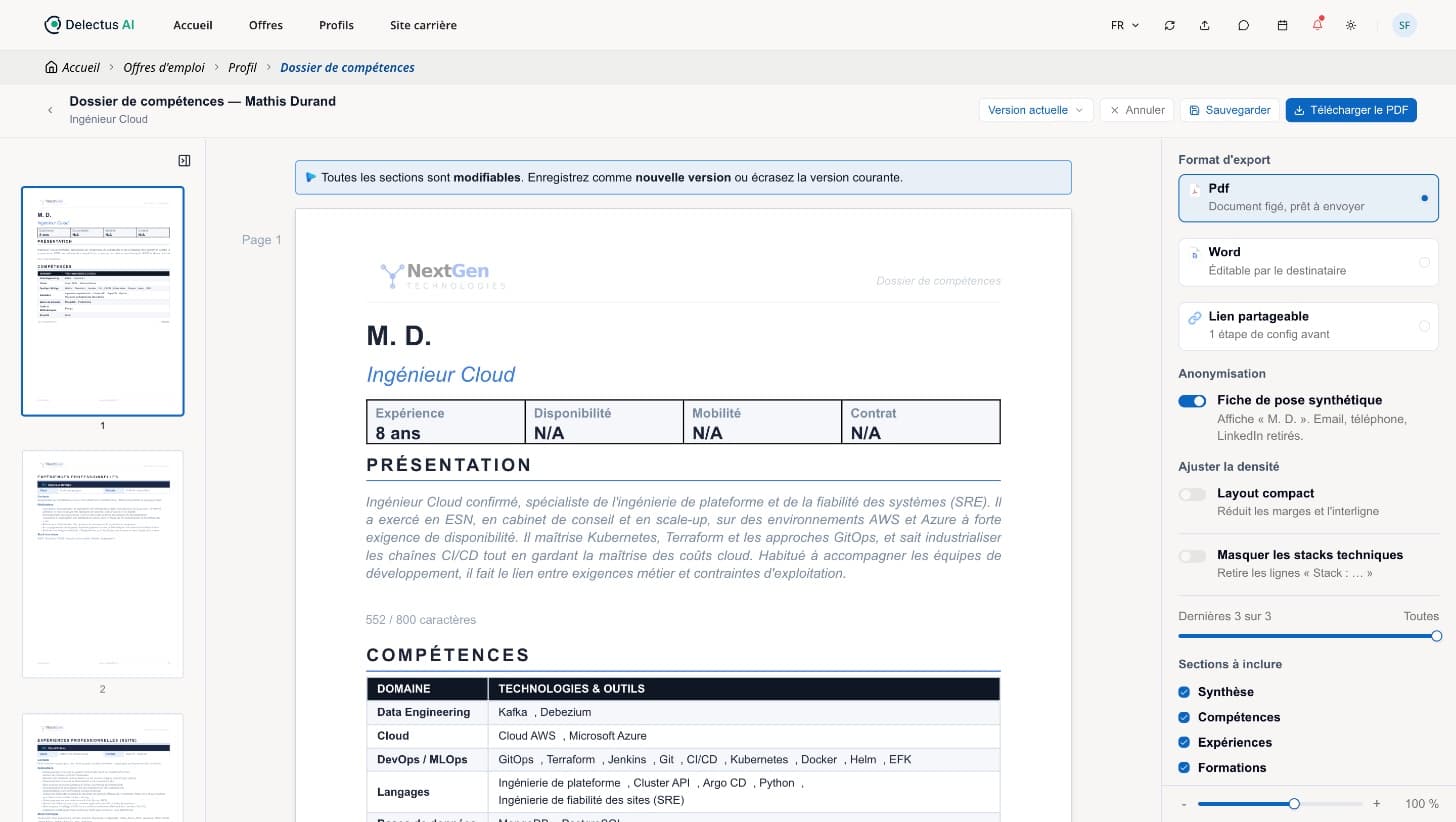
Why consultant profiles take so long
- Resumes in every format. Every consultant writes their resume their own way. Putting it into the firm's format means half an hour lost on every proposal.
- A profile to redo for every engagement. The same consultant isn't presented the same way to a bank and to a manufacturer. So the document has to be reopened every time.
- A client who won't wait. When a client has a need, the first firm to send a strong profile often has a head start.
How Delectus prepares the consultant profile
- You start from the resume. You upload the resume, or pick the consultant from your database, where their background has already been analyzed.
- The profile takes your format. Your template, your branding and your usual sections: summary, skills, experience, education, languages.
- It's angled toward the engagement. The experience closest to the need moves to the top, and the summary uses the vocabulary of the engagement description.
- You review, then send. You export the document or send the client a secure sharing link.
The sections of a good consultant profile
The structure most clients expect from an IT consulting firm. Sections are filled in from the resume, then reviewed by the account manager.
| Section | What it contains | Tip |
|---|---|---|
| Summary | Three to five lines on the profile and its value for the engagement | Reuse the wording of the client's request |
| Key skills | Technologies, methods, functional domains | Give the level or years of practice |
| Experience | Client, dates, role, context, achievements, technical environment | Start with the engagements closest to the need |
| Education and certifications | Degrees, certifications, dates | Keep only what serves the engagement |
| Languages | Languages and level | Specify professional use |
Anonymize the profile if your client asks: initials instead of the name, contact details removed.
What the client actually reads in a consultant profile
A client rarely spends more than a minute on a profile before deciding whether to meet the consultant. They read the summary, glance at the first engagement, then skim the key skills. If those three blocks don't speak to their project, the rest won't be read.
Hence a simple rule. The first engagement shown is the one closest to the need, even if it was three years ago. Skills are ranked by importance for the need, not alphabetically. And the summary uses the words of the engagement description rather than generic phrases.
How to write the summary of a consultant profile
Four to six lines are enough. They should say who the consultant is, what they've already done that's close to the engagement and why they'll be up and running quickly.
An example that works: "Data engineer, seven years of experience including four in banking. Designed and maintained Spark and Airflow pipelines for risk and compliance teams. Used to business teams with high data-quality standards. Available from next month."
Leave out "passionate", "detail-oriented" or "proactive". The client can't do anything with them. They're looking for an industry, technologies, a team size, a responsibility they can check in the interview.
Before and after: a well-written engagement
Here's what you still often see: "Java application development. Attended meetings. Maintenance." And the same engagement, rewritten properly: "Retail bank, team of 8. Developed payment APIs in Java 17 and Spring Boot, migrated to Kubernetes. Reduced wire transfer processing time."
The second version gives the client the context, the role and the result, with the technologies they're looking for. That's what Delectus produces from the resume and the conversations with the consultant. The account manager reviews it before it's sent, because they're the one who knows the client.
Presenting technical skills without overwhelming the client
A list of forty technologies says nothing. The client can't tell which ones the consultant uses every day and which ones they came across once in a training course.
Instead, group skills by area (languages, frameworks, cloud, databases, methods) and give a level or length of practice for each. Put the ones the engagement calls for first. And don't hesitate to remove anything dated that adds nothing to the need: a shorter profile reads better.
Tailoring a consultant profile to each engagement
The same consultant can be put forward for very different engagements. For a cloud migration, you'll highlight their Kubernetes project. For a banking environment, their engagement at a financial institution, even if it's older.
Tailoring doesn't mean inventing. The experience stays the consultant's own; only the order, the summary and the level of detail change. Delectus reorders and rewords based on the engagement description, and the account manager approves.
Who prepares and uses the profile in an IT consulting firm
The profile passes through several hands. The account manager sends it to the client with the commercial proposal. The presales team includes it in responses to tenders. The recruiter prepares it for a candidate hired for an engagement. And the consultant reviews it, because they're the one who will have to stand behind every line in front of the client.
In a tender response, the buyer often imposes a format and asks for one profile per team member. When every profile starts from the same template and is generated from the resumes, presales can wrap up the response without spending the night on layout.
From resume to consultant profile, in Delectus
When a resume comes in, the AI extracts the candidate's background and turns it into a structured profile: experience, skills, education, languages. The consultant profile is generated in your template from that structured profile, not from a copy-paste of the resume. All the account manager has left to do is review, fix a phrase or add a detail picked up in conversation with the consultant.
Every profile keeps its versions. You can find the one sent to a given client for a given engagement, and start from the latest one for the next proposal instead of starting over. To send it, a sharing link is enough: the client opens the profile without creating an account.
Mistakes that get a good consultant passed over
Some flaws are enough to make a strong profile slip through the cracks.
- A generic summary that could describe anyone
- Engagements listed with no context or result
- Skills with no level or length of practice
- A six-page document where the key engagement comes at the end
- Typos, or a layout that changes from one profile to the next
Designed with an IT consulting firm
Consultant profile generation was built with IT consulting firms that use it every day, in the format they were already sending their clients. Data stays in your workspace, hosted in the European Union.
Frequently asked questions
What is a consultant profile?
It's the document an IT consulting firm or an agency sends its client to present a consultant. It includes a summary of the profile, skills, detailed experience and education, in the firm's format and often tailored to the engagement.
What's the difference between a resume and a consultant profile?
The resume is written by the candidate, however they see fit. The consultant profile is formatted by the firm, in its branding, and angled toward a specific engagement.
How do you write a consultant profile?
Start from the resume and the engagement description. Write a summary focused on the engagement, list the key skills with their level, then detail the relevant experience with the client, dates, context, achievements and technical environment. Delectus prepares this structure from the resume.
Can we use our own template?
Yes. The profile is generated in your template, with your sections and your branding.
Can the profile be anonymized?
Yes, if the client asks. The consultant's name and contact details are then removed.
Is there a free consultant profile template?
The sections described on this page form a template you're free to reuse. With Delectus, it's your own template that's applied to each consultant.
How long should a consultant profile be?
Two to four pages in most cases. Beyond that, the client only reads the first one.
Who writes the consultant profile in an IT consulting firm?
Most often the account manager or the recruiter, from the resume and a conversation with the consultant. The consultant then reviews it to check that their engagements are described accurately.
Should the profile be updated after every engagement?
Yes. Adding the engagement that just ended, while it's still fresh, saves you from redoing everything the day a client request lands.