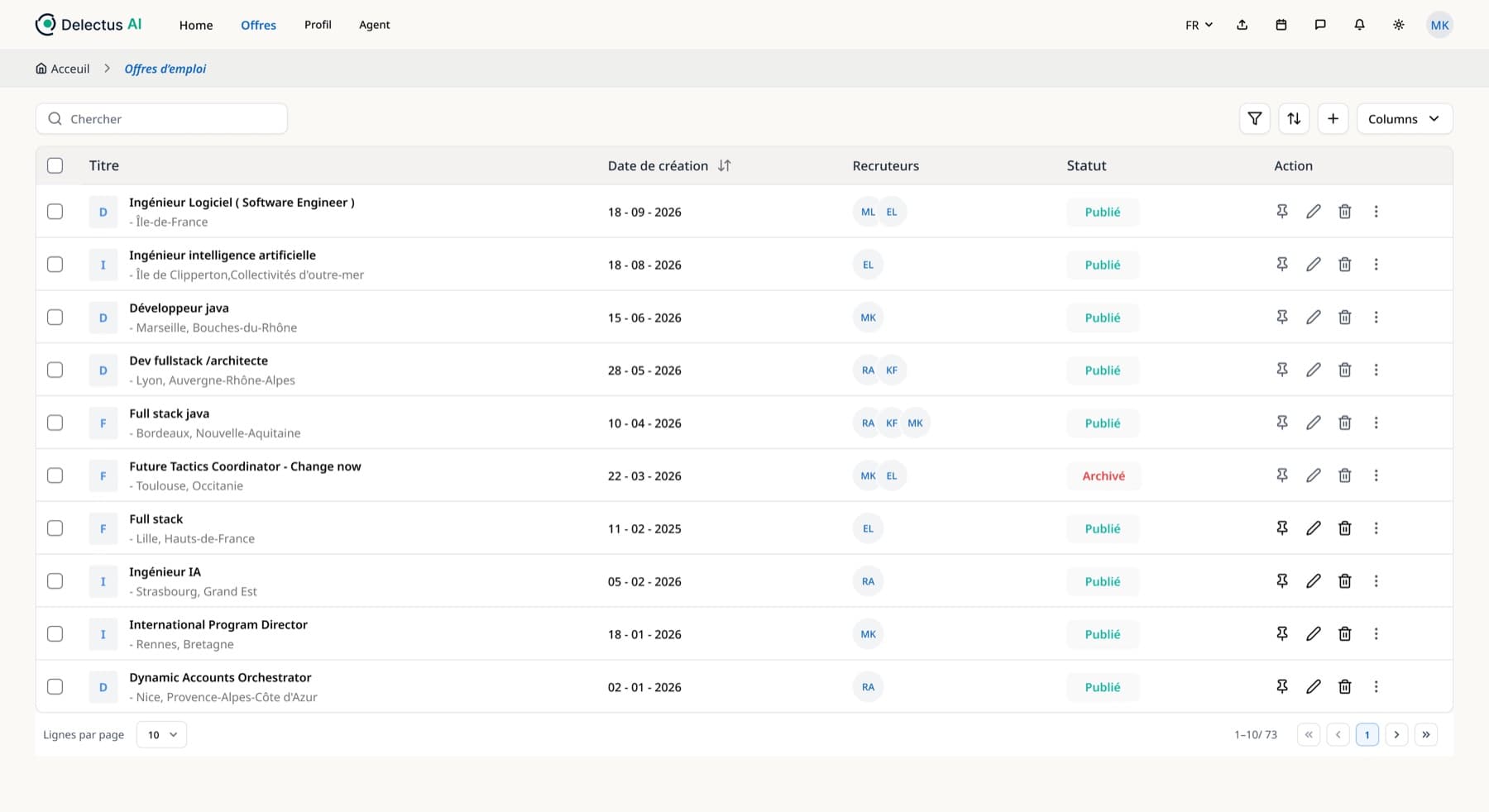
What an ATS doesn't do
- It stores, it doesn't read. The ATS files resumes into columns. Reading them, comparing them to the role and ranking them is still human work.
- It tracks, it doesn't follow up. A candidate's status changes when someone changes it. Nobody calls the candidate for you.
- It archives, it doesn't evaluate. Interview notes are typed in by hand, with as much precision as there's time for.
How Delectus plugs in
- Connecting to your ATS. Job openings, applications and resumes come in automatically, read-only.
- The agents get to work. They analyze resumes, prescreen candidates, and prepare and then evaluate interviews, for the candidates in your job openings.
- The results come back. Rankings, prescreening answers and evaluations are gathered in Delectus, for the whole team.
ATS alone, Delectus alone, or ATS with Delectus?
Three ways to set yourself up, depending on what you already have.
| ATS alone | Delectus alone | ATS with Delectus | |
|---|---|---|---|
| Applicant tracking | Yes | Yes | In your ATS |
| Reading and ranking resumes | Manual or with filters | By the AI, with reasons | By the AI, with reasons |
| Prescreening | Manual | By the agent | By the agent |
| Interviews | Scheduling | Kit, transcript, evaluation | Kit, transcript, evaluation |
| Best for | Teams that screen by hand | Small businesses and organizations without an ATS | Teams that already have an ATS |
ATS: definition
ATS stands for applicant tracking system. It receives applications from every source, files them by job opening and tracks each candidate's progress, from application to hire or rejection.
Most ATSs add job posting distribution to job boards, a careers page, interview scheduling and reporting. They organize the work well. The work itself, however, still has to be done.
How does an ATS work day to day?
An ATS tracks each candidate through a pipeline. Applications come in from the careers page and job boards, the recruiter moves them from one stage to the next, hiring managers give their feedback, and every exchange is kept in the candidate profile.
What takes time happens between two stages. You have to read the resume, call the candidate, prepare the interview, then write the interview summary. That's the work the agents take on.
ATS and AI: what AI actually adds
Added to an ATS, AI takes on the tasks the software left to recruiters.
- Reading every application as it arrives, turning it into a structured profile and ranking it with an explained match score
- Finding past candidates in the database who match a new job opening, and recommending them as soon as it's posted
- Contacting candidates for prescreening, by phone, text or WhatsApp
- Preparing a question kit for each role, then transcribing the interview and writing the interview summary
Prescreening your ATS candidates by text and phone
The candidates in your job openings come in from your ATS. The SMS prescreening agent contacts them, says it's an AI, collects their consent and asks the job's questions. The voice prescreening agent calls them at the agreed time, or when texts go unanswered after two follow-ups.
The answers, transcript and summary are then visible to your team. When a candidate fits, the agent offers them a meeting in your actual free slots, thanks to the calendar synced with Outlook and Teams.
What doesn't change for your team
Plugging AI agents into your ATS doesn't upend anyone's habits. Your job openings are still posted from the ATS, and candidates apply through the same channels. Hiring managers keep their tool and their way of giving feedback, and decisions are still made by your team.
What changes is what your team finds when they open an application in Delectus. The resume is already analyzed, a summary sets out the candidate's strengths and gaps, and the prescreening answers are stored in the candidate profile.
ATSs already connected, and the no-ATS case
Delectus connects to most ATSs on the market, from French software such as Welcome to the Jungle, Flatchr, Taleez or Digitalrecruiters to platforms such as Teamtailor, Workable, SmartRecruiters or Bullhorn. Each compatible ATS has its own page in our ATS integrations. The connection is set up during onboarding, read-only, and job openings and applications then come in with no double entry.
Without an ATS, the tool works on its own. Each job opening has its own kanban pipeline, and each candidate profile brings together the parsed resume, your notes, tags, expected salary, notice period and activity history. The calendar is built in, tasks are shared between team members, and a notification arrives as soon as a candidate replies. For a small business hiring without a dedicated tool, that's often enough.
What's the difference between an ATS, a recruiting CRM and AI recruiting software?
An ATS tracks applications for open roles. A recruiting CRM nurtures relationships with potential candidates, even before a role exists. AI recruiting software does part of the work: reading, reaching out, preparing and evaluating.
Delectus can be added to an existing ATS or cover applicant tracking for organizations that don't have one. Its candidate database, searchable in plain language, also plays part of a CRM's role, since it surfaces past candidates at the right moment.
How to choose an ATS
For a small business or a large group, the selection criteria are the same.
- The number of job openings and applications handled each month
- Distribution to the job boards you use
- How easy it is for hiring managers to give feedback on candidates
- Integrations with email, calendar and your HRIS
- Data hosting and GDPR compliance
Mistakes to avoid when choosing an ATS
A few mistakes come up often when choosing an ATS.
- Choosing from the feature list rather than from how you actually recruit
- Forgetting hiring managers, who need to be able to give feedback easily
- Not checking that you can export your data if you switch tools
- Underestimating the time needed for setup and training
Free ATS: what you need to know
Several vendors offer a free ATS, often limited in the number of job openings, users or features. It's a good way to get started. Before choosing, check what becomes paid and whether you'll be able to get your data back the day you switch tools. If you keep a free ATS for tracking, the agents can be added on top for the work on candidates.
Frequently asked questions
What is an ATS?
An ATS, or applicant tracking system, is software for tracking job applications. It centralizes job openings, the resumes received and each candidate's progress through the hiring process.
Do I need to replace my ATS to use AI?
No. Delectus connects to your ATS and adds AI agents to it, and your team keeps its habits.
Can Delectus be used as an ATS?
Yes, for companies that don't have one. It manages job openings, applications, the pipeline and the candidate database, on top of the AI agents.
What's the difference between an ATS and recruiting software?
The ATS is the core of recruiting software: applicant tracking. Recruiting software can add job posting distribution, a candidate database, candidate evaluation or AI agents that do part of the work.
Which ATSs are most widely used?
In France, you often come across Welcome to the Jungle, Flatchr, Taleez, Digitalrecruiters, Teamtailor or Workable, and Bullhorn in recruitment agencies. Delectus connects to most of them.
Does an ATS automatically reject resumes?
Some ATSs filter applications by keywords or knockout questions. Here, the AI ranks and explains, and no candidate is rejected without a human decision.
How do I connect Delectus to my ATS?
An administrator of your ATS authorizes the connection from Delectus during onboarding. Job openings and applications then come in automatically, read-only.
Does a small business need an ATS?
Not necessarily. A small business hiring for a few roles a year can use the tool directly, since it includes applicant tracking.