Where long bench time comes from
- An available consultant nobody sees. A project comes in and you search outside, when one of your own consultants could have fit.
- A profile stuck on the last assignment. The consultant profile hasn't changed in two years. It has to be reworked before it goes out, and the client is waiting.
- A missed client interview. The right profile, poorly prepared, doesn't get through the meeting. And the bench time drags on for a few more weeks.
How to reduce bench time with Delectus
- Your consultants first. For every new project, the matching profiles in your database are suggested first, with the reasons.
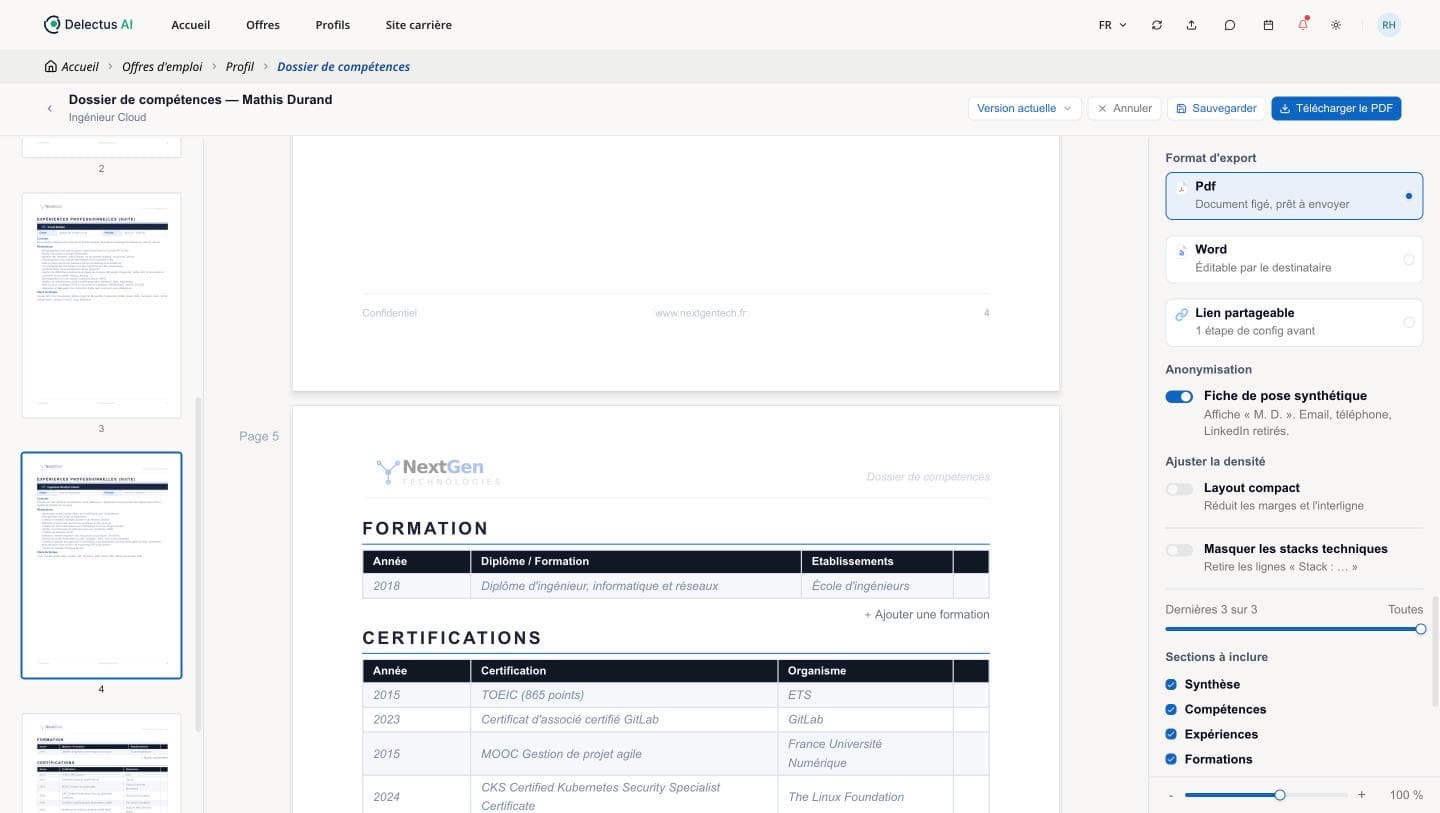
- The profile updates itself. The consultant profile is regenerated and geared toward the new project.
- The consultant rehearses. An AI mock client interview, then a report to fix what needs fixing.
The metrics for managing bench time
Five metrics are enough to track bench time week to week.
| Metric | What it measures | How to calculate it |
|---|---|---|
| Bench rate | The share of unbilled time | Bench days ÷ consultants' available working days |
| Average bench duration | The time it takes to redeploy a consultant | Total bench days ÷ number of bench periods |
| Cost of bench time | What bench time costs the firm | Bench days × average daily rate |
| Client interview conversion rate | How effective submissions are | Projects won ÷ client interviews held |
| Client response time | Sales responsiveness | Time between the client request and sending the profiles |
Why bench time costs an IT consulting firm so much
A consultant on the bench is still an employee. Their salary and payroll costs come due every month, with no invoice to match. For a consulting firm whose margin depends on its utilization rate, a few weeks per consultant per year end up weighing heavily.
There's a less visible cost too. A consultant who waits too long loses motivation, and that's often when they say yes when another firm calls.
Calculating the cost of bench time at your firm
The calculation fits on one line. A day on the bench costs the consultant's fully loaded daily salary, plus the margin they would have brought in if they'd been billed. Cost of one day = fully loaded daily salary + (daily rate − fully loaded daily salary). In other words, each lost day is worth roughly the consultant's daily rate.
Multiply by the number of bench days in the year, then by the number of consultants involved. Run the numbers with your own figures: you'll know what each day saved on a redeployment is worth.
Suggesting your consultants before searching outside
The first reflex when a client request comes in should be to look at who's available in-house, or soon will be. In Delectus, the firm's consultants sit in the same database as candidates. When you enter the project brief, the tool ranks the matching profiles, with a score and the reasons behind it: a past assignment, a technology, years of practice.
You can refine by experience, skill or location, or simply ask in natural language, for example “data consultants available within two months, comfortable with Airflow.” And when a new project resembles the background of a consultant or a past candidate, the tool surfaces them on its own, without anyone thinking to look.
Example: a consultant finishing an assignment
A data consultant's assignment ends in six weeks. A client has a data engineering need, and she shows up among the database's profiles, with the reasons. Her consultant profile is regenerated with her Spark and Airflow assignments, the closest to the need, moved to the top. Before the meeting, she takes a mock client interview and reads her report the night before.
What changed isn't the account manager's work. It's that they see the right consultant at the right time, with a profile ready to send the same day.
Reconnecting with your consultants and talent pool by text or phone
When a request comes in, you still need to know who's really available: consultants finishing an assignment, past candidates, people you met last year. The SMS prescreening agent writes to them, introduces itself as an AI, gets their consent and checks availability, daily rate or salary, and willingness to travel. If two answers contradict each other, it asks for clarification.
With no reply after two follow-ups, the voice prescreening agent calls them. If they stay unreachable, the account manager is alerted. They get a notification as soon as a profile replies, and find the answers, the transcript and the call summary in the candidate profile.
The consultant profile, ready the day the request lands
Bench time often comes down to how fast you respond to the client. In Delectus, each consultant's profile keeps its versions. For a new project, you start from the latest one, the AI moves the experience closest to the need to the top and rewrites the summary, and you review before sending.
The client gets a share link and opens the profile without creating an account. You know which version they received, which avoids confusion when the same consultant is submitted to two clients.
Preparing the consultant for the client interview
A consultant coming off two years with the same client has sometimes fallen out of the habit of interviewing. The mock client interview starts from the project brief and their profile: the AI asks them about what the client is going to read and what the client expects. The consultant takes it whenever they can, from their browser, and gets a report that tells them what to work on.
Who handles redeployment?
At most IT consulting firms, it's the account manager who handled the previous assignment, sometimes with help from the recruiting team. The risk is that only they know a consultant is available, while a colleague searches outside for a profile the firm already has.
A shared database avoids that. Consultants appear next to candidates, with their tags, notes and the history of every conversation. Submissions are tracked in a kanban pipeline, and team members split up follow-ups as tasks. Everyone can see who was submitted, to which client and with which version of the profile.
A weekly bench management routine
Firms that keep bench time low hold a short check-in every week. They review assignments ending within three months and consultants already available. For each open client request, they look first at the profiles suggested from the database. They update the profiles of the consultants involved and schedule mock interviews ahead of upcoming meetings.
At the end of the week, a glance at the pipeline is enough to see which submissions went out and which client responses are pending.
The mistakes that stretch out bench time
Waiting until the assignment actually ends to look for the next one. Searching outside out of habit, without checking the database. Sending an outdated profile that doesn't mention the latest assignment. Submitting the consultant without preparing them for the client's context. Leaving them without news for weeks.
Each one maps to a step the tool covers: profiles suggested as soon as a request arrives, the regenerated consultant profile, the mock interview, follow-ups by text or phone.
What Delectus does, and what it doesn't replace
The platform doesn't replace your resource management tool or your sales tracking. It steps in when a client request comes in, on the three steps where bench time is won or lost: finding the right consultant, sending an up-to-date profile and nailing the client interview.
Bench time: what the rules say in France
During bench time, the consultant remains an employee of the consulting firm and keeps receiving their salary. The firm can assign them training, internal projects or pre-sales work. The exact terms depend on the employment contract and the applicable collective bargaining agreement.
Frequently asked questions
What is bench time?
It's the period when a consultant employed by an IT consulting firm isn't assigned to any client project. They're still paid without being billed, which eats into the firm's margin.
How do you reduce bench time?
By suggesting your own consultants first for new projects, keeping their consultant profiles up to date and preparing them for client interviews. Delectus helps with all three steps.
What can a consultant do while on the bench?
Train, update their consultant profile and rehearse client interviews, so they're ready as soon as a project comes up.
How long can bench time last?
There's no typical length. A few days between two assignments, sometimes several months. The longer it lasts, the more it costs, which is why it pays to suggest the consultant as soon as a matching request comes in.
Is there a difference between bench time and time between assignments?
No. Both refer to the period between two client assignments during which the consultant remains an employee of the firm.
How do you measure bench time?
The most common measure is the bench rate: the share of consultants' available time that isn't billed. It's tracked consultant by consultant and for the firm as a whole.
How do you calculate the cost of bench time?
Each day, the firm pays the consultant's fully loaded salary and loses the margin it would have billed. So one day costs roughly the daily rate. Multiply by the number of bench days to get the total.
Can a consultant turn down a project while on the bench?
It depends on their employment contract, the project offered and the collective bargaining agreement. When in doubt, it's a question for HR or an employment lawyer.