What a scorecard prevents
- The overall impression. Without criteria set in advance, you remember how at ease the candidate was and the last five minutes of the conversation.
- Recruiters who don't rate the same way. One person's "good" is another's "average". Between two candidates for the same role, nobody can make the call anymore.
- A decision that's hard to justify. When it's time to wrap up, you have to dig through your notes to remember why you preferred one candidate.
Building your scorecard in four steps
- Start from the role's responsibilities. Each criterion maps to a real responsibility. "Team player" on its own doesn't mean much.
- Limit it to five or six criteria. Beyond that, the scorecard becomes a checklist you rush through at the end of the interview.
- Define the scale with examples. For each criterion, describe what a 1, a 3 and a 5 answer look like.
- Rate right after the interview. Do it with the candidate's own words in front of you, not from memory the next day.
Interview scorecard template
Here's a generic scorecard to adapt to your role. Each criterion is rated from 1 to 5, and each rating is backed by something said during the interview.
| Criterion | What you're looking for | 1 — insufficient | 5 — excellent |
|---|---|---|---|
| Technical skills | Command of the role's tools and methods | Theoretical knowledge, no concrete example | Specific examples, measurable results, known limits |
| Comparable experience | Responsibilities already handled in a similar context | Context very far from the role | Equivalent responsibilities, at the same or a higher level |
| Problem solving | How they analyze a difficulty and act | Vague or generic answer | Structured approach, alternatives considered, outcome explained |
| Communication | Clarity, listening, ability to explain simply | Confused, off-topic answers | Clear answers, adapted to the audience |
| Motivation for the role | Understanding of the role and the company | Generic motivation | Specific expectations, consistent with the role |
| Practical requirements | Availability, pay, location | Incompatible with the role | Fully compatible |
Keep a "watch points" line under the scorecard for anything still to check, through references or in the next round.
How to fill in an interview scorecard
During the interview, write down facts rather than impressions. What situation does the candidate describe, what did they do themselves, and what came of it? The ratings come right after, as you reread those facts, with one sentence to justify each.
A rating with no justification is useless on the day you have to choose between two finalists. One sentence from the candidate, even a short one, is enough to remind you why you gave a 4 rather than a 3.
Example of a filled-in interview scorecard
Take a project manager role, after a one-hour interview. Each rating rests on something the candidate said.
- Comparable experience, 4/5: "I led the rollout of a new tool across six branches, with a monthly steering committee."
- Organization, 4/5: described a schedule reviewed every week and how they handled a supplier delay by negotiating to push back one work package
- Communication, 3/5: clear answers, but few examples of interactions with senior management
- Conflict management, 2/5: a single example that stayed general; to dig into in the next round
- Motivation for the role, 5/5: knows the company's project, asked specific questions about the team and timelines
- Watch points: check communication with senior management and conflict management in the second interview
Which rating scale should you use for an interview scorecard?
Three scales come up often. A 1-to-4 scale forces you to decide, since there's no middle score to hide behind. The 1-to-5 scale is still the most common and keeps a midpoint for "meets expectations". For a first round, three levels are often enough (below, meets, above).
Whatever the scale, describe at least the lowest and highest levels with concrete examples, as in the template above. Two recruiters reading the same description end up rating the same way.
How to weight the criteria on an interview scorecard
Not every criterion carries the same weight. On a technical role, technical skills may count double, while in a customer-facing role it's more likely communication. Set the weighting with the hiring manager before the interviews and don't change it along the way.
A knockout criterion, such as a mandatory certification, is handled separately. It's checked during prescreening, and it isn't added to the other ratings.
Interview scorecards and debriefs with several interviewers
When several people meet the same candidate, each one fills in their scorecard alone, before any discussion. Otherwise, the first opinion voiced rubs off on all the others, and it's often the one from the most experienced or most convinced person in the room.
Then start the debrief with the criteria where ratings differ. That's where the discussion really adds something. The criteria everyone agrees on are signed off in a minute.
Mistakes that skew a scorecard
A scorecard doesn't protect against everything. Four biases come up often, even among experienced recruiters.
- The halo effect, when one strong quality inflates the rating on every other criterion
- Central tendency, which pushes you to rate everything 3 out of 5 to play it safe
- The contrast effect, which judges a candidate against the previous one rather than against the criteria
- Similarity bias, which makes you favor candidates who are like you
The interview scorecard in Delectus
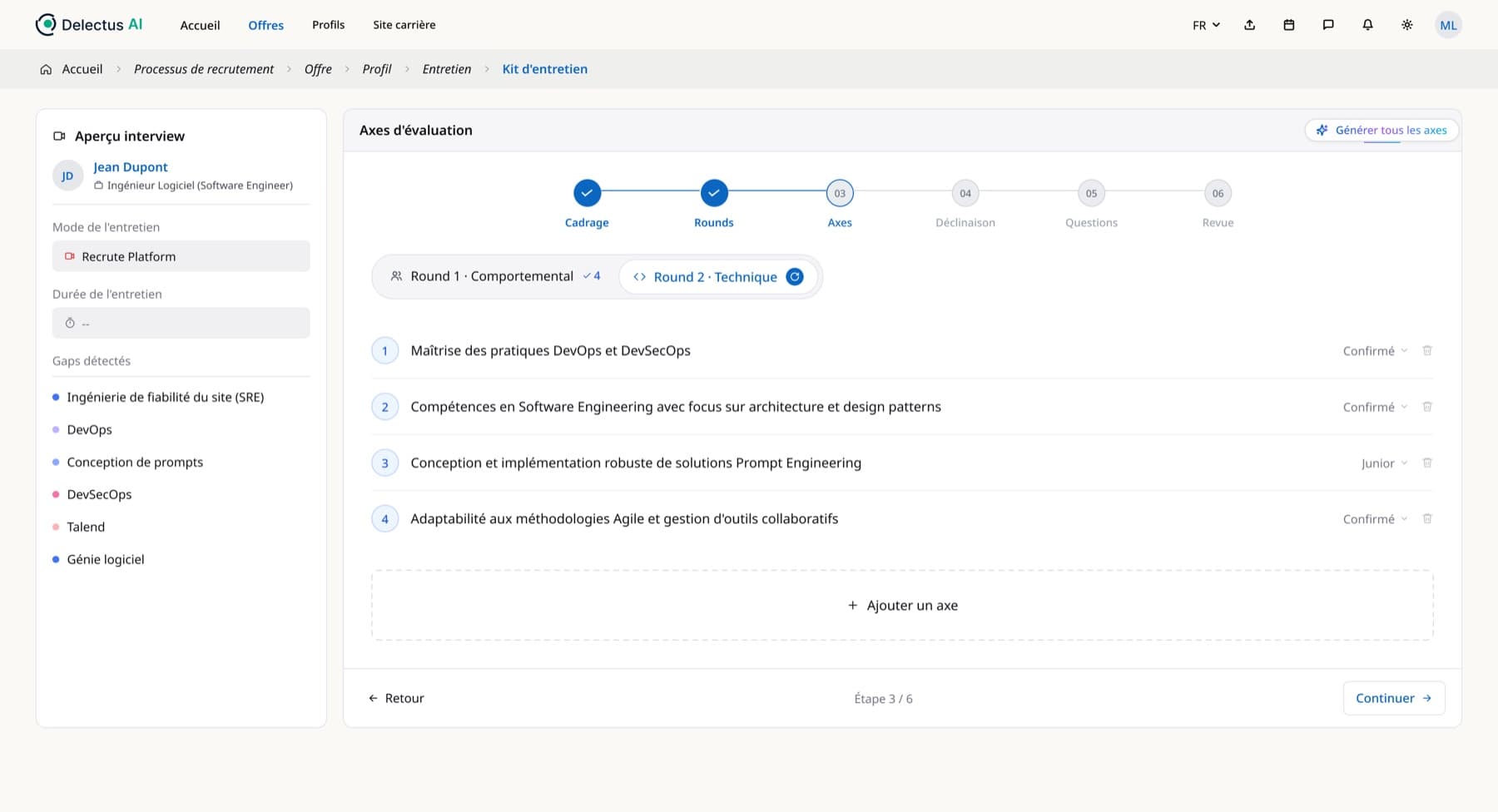
In Delectus, the scorecard is part of the role's interview kit. The evaluation areas are drawn from the job opening, each with preconfigured questions and rating criteria. You adjust them once, and every interviewer for the role then rates on the same basis.
When the interview takes place by video in the platform, the conversation is transcribed in real time. Each answer gets a score question by question, and the end-of-interview report shows a suggested rating for each area, backed by the candidate's exact words, along with an analysis by theme: technical skills, soft skills and motivation. The recruiter approves or corrects each rating. The recording stays available so you can replay a moment before the debrief.
Frequently asked questions
What is an interview scorecard?
It's a table that lists the criteria to assess during a job interview, with a rating scale shared by everyone. It lets you compare candidates for the same role on the same basis.
How is it different from an interview evaluation form?
The principle is the same. "Scorecard" usually refers to the grid defined before the role opens and shared by everyone involved in the hiring process.
How many criteria should a scorecard have?
Five or six for a one-hour interview. With more, you rate too quickly and the scorecard loses its value.
Can you use the same scorecard for every role?
The structure can stay the same, but the technical criteria inevitably change with the role. That's why Delectus prepares a scorecard for each job opening.
How do you evaluate a candidate in an interview?
Rate each of the role's criteria based on the facts the candidate describes, on a shared scale, and justify each rating. That's exactly what an interview scorecard is for.
What scale should an interview scorecard use?
The 1-to-5 scale is the most common. A 1-to-4 scale avoids the middle score and forces a decision. Either way, describe each level with examples.
Should you show the scorecard to the candidate?
Nothing requires you to, but the candidate can request access to the information about them. All the more reason to write down facts and justify every rating.