Screening resumes by hand
- Too many applications for the time you have. On an attractive opening, resumes come in by the dozen. You skim them quickly, and a strong candidate can slip under the radar.
- Criteria that shift from one reader to the next. Two people don't screen the same way, and the same person doesn't screen the same way in the morning and in the evening. That makes the shortlist hard to justify afterwards.
- Candidates left waiting. Every day without a reply gives another company time to make an offer.
How resume screening works
- You set your criteria. When you open the role, you list the must-have skills, the nice-to-haves and any knockout criteria.
- The resume is read in full. The AI extracts the candidate's entire background and turns it into a structured profile, whatever the document's layout.
- A score with an explanation. Each candidate gets a match score for the role, along with the parts of the resume that support it.
- You decide. You move the candidate forward, set them aside or send them to prescreening. The AI doesn't reject anyone on your behalf.
Example resume screening for an accountant role
For each of the role's criteria, the analysis shows what the resume says and what it concludes.
| Job criterion | What the resume says | Conclusion |
|---|---|---|
| Three years of general accounting experience | Four years at an accounting firm | Criterion met |
| Month-end and year-end closes | Prepared financial statements for small-business clients | Criterion met |
| Proficiency with an ERP | Accounting software listed, no ERP named | Check during prescreening |
| Professional English | Not mentioned | To be checked |
| Available within two months | Not mentioned | Ask the candidate |
A criterion missing from the resume doesn't rule the candidate out. It becomes a question to ask them.
Keyword screening vs. AI resume screening: the difference
The first screening tools compared words. A resume that said "PostgreSQL" got through; one that said "Postgres" was filtered out. Candidates caught on quickly and now stuff their resumes with keywords, which makes that kind of screening even less reliable.
AI resume screening looks at meaning. It understands that experience "migrating relational databases" demonstrates SQL skills, even if the word appears nowhere. It judges seniority from the responsibilities described rather than the number of years, and checks each knockout criterion you've set, one by one.
How the AI reads a resume, step by step
It all starts with extraction. The AI reads the document and pulls out work history, dates, skills, education and languages. A two-column resume, a designed template or a professional network export all produce the same structured profile, stored in the candidate profile.
Next comes the comparison with the role. Each criterion is looked for in the skills list, but also in the job descriptions, which is often where the most telling details hide. Finally, the AI writes its conclusion, separating criteria that are met, those that are missing and those that still need checking.
What you see in the candidate profile
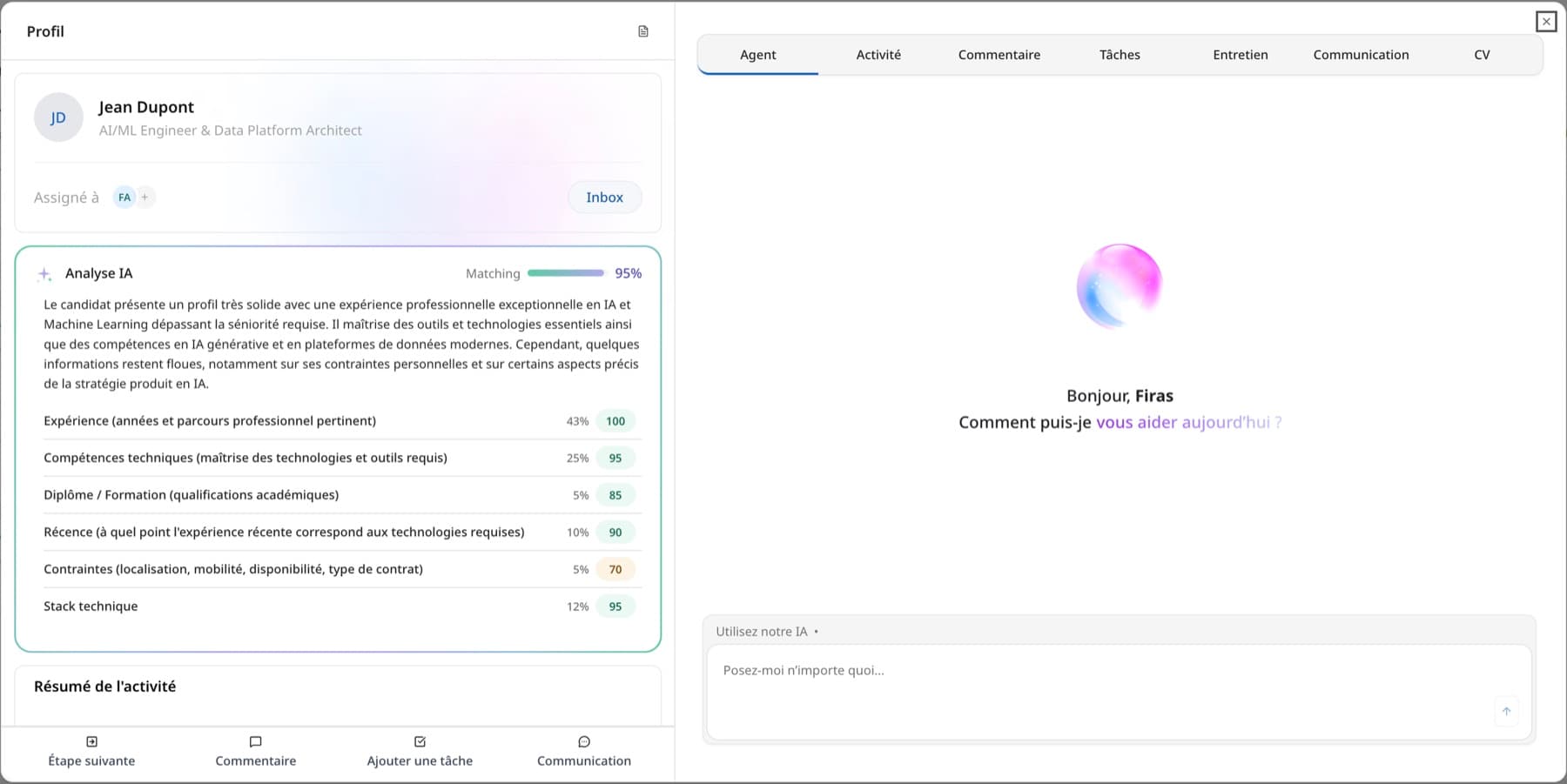
At the top of the profile, a short summary sums up the candidate, with their strengths and gaps for the role. Below it, the match score is broken down criterion by criterion, and each conclusion links to the part of the resume it's based on. You can see at a glance why a candidate is at the top, and what you'll need to ask them.
If something isn't clear, you can question the profile with the AI chat. Ask, for example, whether they've managed a team before or how long they've used a given piece of software, and the answer quotes the resume. Your notes, tags and expected salary live in the same profile, along with the history of everything that's happened since the application.
What criteria should you give resume screening?
The quality of the screening depends on the criteria you give it. The most useful ones describe what the person will have to do, not the ideal profile you have in mind.
- Prefer "has handled month-end closes" over "detail-oriented"
- Limit must-have criteria to three to five; the rest are nice-to-haves
- Avoid criteria unrelated to the job, such as school or age, which are also a source of discrimination
- Keep knockout criteria for genuine requirements, such as a regulated degree, a security clearance or a driver's license
Screening a job opening's resumes with AI
Applications land in the job opening's pipeline already analyzed and ranked by score. You can filter the list by experience, skill or location, and compare candidates on the same criteria. Start at the top of the ranking, then look at a few profiles further down to check that your criteria really say what you're looking for.
For the candidates you shortlist, the next step starts from the list. The SMS prescreening agent texts them to check availability, expected salary or willingness to relocate, and the voice prescreening agent calls them if the texts go unanswered. Their answers fill in the candidate profile, and you're notified as soon as a candidate replies.
Reply quickly, including to the candidates you don't move forward. The kanban view shows where everyone stands, so no application is left without news.
Resume screening works on past candidates too
Resumes received for past job openings are analyzed again for every role you open. When you post a job, the tool recommends past candidates from your database who match it, with their score and its reasons. A finalist from a previous search or an unsolicited application from last year can end up back at the top of the list.
Resumes you import follow the same path. Each one is extracted, turned into a structured profile and compared with your open roles.
When does resume screening save the most time?
The gain is clearest on openings that receive lots of applications, when manual screening stretches over several days. It's also clear on technical roles, where skills are hidden in project descriptions rather than in a list.
Also think of hiring led by a manager, who doesn't have time to read every resume but needs to be able to justify their choices. They read the summary and the score breakdown, and only reopen the full resume for the candidates they're interested in.
Bias in resume screening, and how AI helps limit it
Manual resume screening is exposed to well-known biases: school, name, a photo or a gap in someone's career. Screening based only on the job's criteria, applied the same way to every resume, reduces the influence of those factors.
AI isn't neutral by nature. It has to work from job-related criteria, and its rankings have to be reviewed. That's why every score is explained and the decision stays with the recruiter.
Mistakes to avoid with a resume screening tool
A screening tool doesn't replace reviewing. The most common mistakes are only looking at the top of the ranking, never checking the reasons given, or copying poorly worded criteria from one role to the next. If a candidate seems ranked wrong, open the score breakdown. Most of the time, it's a criterion that needs rewording.
Frequently asked questions
How do you screen resumes quickly?
Set your criteria once, then let a tool apply them to every application as it arrives. With Delectus, each resume is analyzed and ranked automatically, and you only review the shortlisted candidates in detail.
Can the AI reject a candidate on its own?
No. It ranks and explains; rejection remains a human decision. That's also what European law requires for decisions that affect a person.
Which resume formats are supported?
PDF resumes, whatever their layout, including columns, tables or designed templates.
Are screened resumes used to train a model?
No. Resumes stay in your workspace and aren't used to train any model.
What is resume screening?
It's reading a resume to judge whether it fits a role, looking at experience, skills, education and seniority. When AI does it, it applies to every application as it arrives, with the same criteria for each one.
Can you screen a resume for free?
Online tools let candidates have their own resume analyzed. For a recruiter the question is different, since the job is to screen every resume for an opening against the role's criteria. That's what Delectus does.
Is AI resume screening reliable?
It is when the criteria are clear and its conclusions are checked. That's why every conclusion quotes the parts of the resume that support it, which you can verify at a glance.
What happens to a candidate the AI ranks poorly?
They stay visible in the list of applications. You can review them, move them forward or send them to prescreening.